Customers often search for books (especially nonfiction titles) using the keyword search feature on Amazon. To perform a keyword search, select "Books" from the drop-down menu near the top of the home page, then enter keywords in the search box to the right. From the next screen, you can click on the "Advanced Search" button to perform a more specific search.
Wednesday, December 1, 2010
Customers often search for books (especially nonfiction titles) using the keyword search feature on Amazon. To perform a keyword search, select "Books" from the drop-down menu near the top of the home page, then enter keywords in the search box to the right. From the next screen, you can click on the "Advanced Search" button to perform a more specific search.
Sunday, November 28, 2010
1. Author Interview: Tom Llewellyn
2. What's It REALLY Like to be a New York Times Bestselling Author?
3. How Do Books Get Stocked in Bookstores?
4. How to Market Your Book on Facebook
5. How to Sell Your Books in Bulk
Friday, June 4, 2010

I have mentioned previously how books get stocked on bookstore shelves, how difficult it is to get a book stocked in bookstores, and why bookstores may not even be the best option for authors.
I'm not trying to give the impression that authors shouldn't care if their book is available in a bookstore. Bookstores do sell books. However, when it comes to book sales and what the best venue is for a particular book, they are not the only game in town. Authors run into problems when they focus on bookstores at the expense of all other marketing avenues. Bookstores should be a part of every author's marketing plan, but they should not be the ONLY part of an author's marketing plan. Some authors are under the impression that if only their book were available in every bookstore in the country, or in a major bookstore chain, it will sell. Of course, that is not necessarily true. As book marketer Brian Jud has stated, "bookstores display books. They do not (actively) sell them." If a book hits a bookstore shelf and doesn't sell, it's going straight back to the publisher, and the author is going to get socked with returns.
Recently, I have been receiving a lot of questions from authors in regard to distribution. It is usually a panicked email or phone call from the author stating an online bookseller or bookstore is "out of stock" and readers are "unable" to order their book. It's costing the author sales!
Well, not necessarily. The main distributor that my publishing company works with is Ingram/Spring Arbor, but that is really beside the point. No distributor carries an unlimited quantity of any title. They order what they think they can sell to the online booksellers and to the bookstores. Occasionally, the distributor does run out of books. This is a common occurrence and is no cause for alarm. They will reorder more.
In the meantime, bookstores or online booksellers have the option of taking back-orders for a title, and then shipping them when the distributor receives new stock. Readers may also be able to find copies on Amazon.com, or directly from the publisher. Distributors and publishers only make money when they sell books. They are not going to let any title remain out-of-stock for long. This is why you hear of some publishers having a "second printing" of a title...they ran out of the first printing of books they ordered. The company I work for has a digital print facility. We can print books at will and send them where they need to go. Many publishers are going this route.
Another comment I have been hearing is from authors who say they "don't care" if their book sells once it's at a bookstore or not. At least it's in the store. This makes no sense at all. I guarantee you the bookstore cares, because they are not going to let stock just sit in their store if it's not selling. The distributor cares, because those stores are shipping books back to them, and they are losing money. The publisher cares, because now they aren't getting paid for those books, either. Eventually, the author WILL care because when they receive their royalty statement they will see how much those returns have cost them in lost royalties. It has to make good business sense to physically stock a book at a particular retailer.
Simply sending hundreds or thousands of books to the distributor (which a publisher can't do unless the distributor orders them) will not result in book sales. The same goes for trying to put thousands of books on bookstore shelves across the country (which only the stores can do. It's not up to the publisher, unless they are paying for shelf space). If there is no demand for a title, it's not going to sell no matter how many retailers may have it available, or how many books are on hand at the distributor. Only one thing guarantees large stocks of a title at a distributor or in retailers across the country: demand.
Demand is the reason why you see dozens of copies of CDs from the latest winner of American Idol at Walmart, but only one or two polka CDs. There is more demand for the American Idol winner's music than there is for polka.
With no demand, there is no supply. Bookstores use demand to determine which books they will carry. Distributors use demand to determine how many copies of a title they should have on hand for stores and booksellers to order. The greater the demand, the more books they offer. If there is low demand, you will only see a few copies being stocked by the distributor and only a few venues offering if for sale (if any).
Of course, it is up to the publisher and the author to create that demand through marketing and promotion. If that demand doesn't exist, there will be few copies floating around in distribution or in bookstores. This is the reason why authors need to work to do events, interviews, get book reviews and create "buzz" around their title. It's all about creating demand.
Demand creates the supply of books available, not the other way around. Creating that demand is a job that never ends.
Tuesday, June 1, 2010

Who would sabotage their own book? Authors don't do it intentionally, of course. But, when it comes to marketing their books, authors sometimes do things that could impede their sales, and take what could have been a successful title and relegate it to the bargain table of the local bookstore. Here are a handful of things I have seen authors do that get in the way of sales and success:
1. They give up too early. Authors sometimes spend years writing their books, only to throw in the towel on marketing and promotion after a few months. There is a lot of competition in the marketplace. In fact, last year there were more than a million book titles released in the U.S. Most books don't fly off the shelves of bookstores. It takes patience and persistence (and a lot of hard work) to promote a book, and the author must be involved. No publisher can guarantee book sales, but if the author quits too early I can guarantee the kind of results they will experience. My recommendation is don't quit at all.
2. They expect the book-buying public to beat a path to their door. This isn't true of any author, not even the famous authors. They had to start somewhere, too. Almost every successful author has a rags-to-riches story. They didn't start their writing career being famous, and many slaved away at it for years before they started to reap the fruits of their labor. Too often, authors show up for their book signing events and just sit at their table, waiting for a line of people to form, eager to buy the book and get the author's signature. More often than not, there is no line of people at the table, only customers walking into the store and avoiding eye contact. It is up to the author to engage them.
3. They get "Ernest Hemingway Syndrome." Getting a book published is great, but it doesn't mean the author automatically has the key to fame and fortune. Some authors adopt the attitude that now that they have a book in print the world owes them something. They get angry with bookstore managers who don't schedule them to come in for a book signing event, they get angry with the publisher if they feel their royalty checks are too small, they get angry with media outlets who pass on publishing a story or review about their book. There are NO guarantees in the publishing industry. Rejection is part of the business, and every author has experienced it at some point. The old saying "you'll get more flies with honey than vinegar" is especially true in the publishing industry. Nobody wants to help an author who is too demanding.
4. They don't have a plan. Too many authors expect other people to sell their books for them. Ironically, these are also the same authors who don't sell many books. Even the large publishing houses expect authors to come to the table with something in terms of marketing their book, whether it be a large fan base, a platform from which they can successfully launch their book (such as a popular blog or radio program) or a plan for reaching their target audience. Expecting your book to be stocked in every bookstore in the country is not a marketing plan. If an author doesn't have an idea for who the target audience is for their book, they are going to struggle to find an audience. Authors who know who they have written their book for and how they are going to reach that audience are always a step ahead in the game.
5. They don't listen to professional advice. On the other hand, some authors feel their plan is the ONLY plan which will work at all. They hire a publicist, only to micromanage everything the publicist does to the point of making their efforts ineffective. I once worked with an author who hired an outside publicist, and then proceeded to argue with the publicist every step of the way through marketing. The publicist resigned after a month. Publicists and publishers are the experts and the professionals in the publishing business. Many of them are very good and know what they are doing. Try following their advice now and then and you may be surprised at the positive results. You wouldn't hire a doctor to perform open-heart surgery and then proceed to disagree with him about how he planned to perform the operation, would you? Yet, some authors with no prior experience in publishing will vehemently oppose a publisher's or publicist's marketing plan without first giving it a chance. The professionals who are good at their job will explain what they are doing, and why, each step of the way through the marketing process, and work as the author's partner. If they don't, ask.
These are just a few examples of how an author can sabotage the marketing of their book. Writing a book is a labor of love, but selling a book is business. Approach it as a professional, surround yourself with good people, work hard and treat it as a job (it is) and you'll be giving your book the fair shake it deserves.
Monday, May 24, 2010
Being a First Time Author and Selling Books - A Dose of Reality
By Lynn Baber
It seems that almost every person I meet has either written a book, is thinking of writing a book, or has been told by someone that they should write a book. While I am not technically a first time author, it's been so long since the last one that I don't think it should count against me. Certainly very few people can remember that business book published way back in 1989.
Authorship is Glamorous, Right?
The news reports of book events by authors Sarah Palin, Sean Hannity, and Karl Rove have been making headlines in recent weeks. Their books were published, hit Amazon, and these authors garnered even more fame, money, and celebrity as each scheduled book event drew to a successful close.
"If only I could get my novel published, I could buy that house in the country," one would-be author laments. "Once my work is out there I can quit my office job and stay at home and write," dreams another. All I need is a break, and it's New York Times Bestseller List here I come!
Well, they're right, aren't they?
Nope. That is, of course, unless you already have a built-in audience numbering in the millions just waiting to part with $24.95 for a chance to meet you and get your autograph. If that doesn't describe you, then let me share the facts - just the facts, ma'am.
Publishing a Book is Like Buying a Horse
Not everyone who wants a horse will be able to buy one. Not everyone who has a story will get published. What is common in both the horse and book scenarios is that the upfront cost is the easy part. Once you bring your dream horse home the serious bills begin to mount and the real work begins.
Ditto publishing a book in today's market. Last year there were nearly a million book titles published if you add up the numbers from traditional publishers, self-published books, and e-books. I've seen reports that a successful book in the marketplace today is one that sells 5,000 copies.
Do you know how hard it is to sell 5,000 copies? We'll get back to that in a moment, first let's talk about the fun stuff - the money.
Authors who are published by traditional means are usually paid by royalties. Contracts differ among publishers and authors, but for the sake of argument let's assume you will receive a royalty of 15% of the price the publisher receives for books sold into the marketplace. Please note, your royalty is not 15% of the cover price, but calculated on the amount the publisher receives per copy.
Authors Make Millions
I suppose some do, just as there are folks who win the Lottery. Writing a book and buying a lottery ticket are both bad bets upon which to budget. Just for fun, let's assume your book is one of the few that actually sells 5,000 copies. If your publisher puts a cover price of $19.95 on your book it is entirely possible that the amount received per book will average around eight bucks, more or less. Don't get caught up in details until we wade through the concept part. So, if all 5,000 books are sold and not returned (did I mention that sold isn't always really sold...) the gross amount to your publisher is about $40,000. Congratulations, you are a successful author. Now let's look at your paycheck.
Don't call the realtor yet, your gross royalties amount to $6,000. I won't speculate on what it might cost you to write your book, but I know my office supply store clerk grins every time I come in for more paper and printer ink.
If you're still hankering to get your story or message out, maybe it's time to move on to the issue of marketing; actually selling books.
Selling Books Is Personal
The only way to sell books is to tell your story to the people who are interested enough in the details to write a check, hand over cash, or hover their computer cursor over the BUY NOW button and left-click their mouse.
How do you reach these folks? How will they find your book? The answers are the same. You need to bring it to their attention in any way possible. Creativity is good, but persistence is even better.
First time authors don't usually get promotional tours paid for by publishers. First time authors usually get a listing on the major book sites and distribution channels that will supply books ordered by book stores. Please note, I did not write, "Stocked in book stores."
The most important thing to successfully marketing your book is great content. Your book must be good! The words you write must somehow fill a need in reader's lives: for entertainment, for inspiration, or as a source of needed information.
What comes next is work. Then more work. Just like the horse example, the real effort begins when your book is released. Finishing the final edit on your manuscript barely achieves a beginning if your goal is a successful book.
Is This Where it Gets Glamorous?
Uh, sure, if you think toting boxes of books, tables, chairs, and all the accoutrements necessary to set up an inviting display for book fair patrons is glamorous. Then, there's the matter of initiating conversation with anyone who comes within earshot of your booth. You have to be a people-person to sell books. Did I mention that selling books is personal? Unless you're well known, you are really lucky to have the opportunity to tell each person who approaches your table about your book and why it might matter to them.
The actual value of book signing events is debatable. Book fairs can be long, tiring days. Each author needs to take a critical look at their book and decide if it appeals to a broad enough market to make such events good choices.
How Else Can I Reach Potential Readers?
The article you are reading I wrote for free. Why? I wrote it both as a service to fellow authors, and to let you know I exist. This is one example of book marketing. My usual topics have something to do with horses or faith, but writing and selling books is something I'm getting to know more about each day.
The Internet is a wonderful tool. Each book has a specific market. Your challenge is to reach into your market and speak to the individuals who make up that market. My true goal is to share a message of faith. I use the written word as well as personal appearances and video to get the message out. Once your book is out, and you fully understand that selling copies is a marathon race and not a sprint - then it is time to let your creativity go wild.
The Reality of Authorship
Here's where I share my reality as an author with you. I am passionate about the message I share with my readers. There was never an option of NOT sharing it. I'm in this for the long haul. I hope that when folks close the back cover of Amazing Grays - Amazing Grace, their lives will be forever changed for the better.
Is your message great? Are you passionate about sharing it with others? If you answered both these questions with a loud, emphatic, "YES!", then you just may need to keep after the goal of being published.
Don't plan on paying any big bills with your royalties, but you may just have a message that will make a material difference in the lives of others. What better goal is there?
When that first email arrives telling you that your words 'changed my life', your heart will grow about two sizes and you will head back to the computer to do it all again.
Read excerpts from Lynn's newly released book, "AMAZING GRAYS-AMAZING GRACE: Pursuing relationship with God, horses, and one another" at http://www.AmazingGrays.us or on Amazon.com. Written in a conversational tone, author Lynn Baber uses a variety of literary styles including allegory, analogy, and story-telling to share principles of leadership and faith. Seek freedom with a band of wild horses. Stand beside Lynn as she judges a Western Pleasure class, when she makes the very first connection with an untrained horse in the round pen, and as she shares God's amazing grace that ultimately leads us to heaven. Learn the answers to questions like, "Why won't my horse (child) do what I ask?" or "Why does God let bad things happen."
Article Source: http://EzineArticles.com/?expert=Lynn_Baber
http://EzineArticles.com/?Being-a-First-Time-Author-and-Selling-Books---A-Dose-of-Reality&id=4140254
Friday, May 21, 2010

As an author, one of the terms you may be familiar with by now is returns, but what are they, and how do they affect you, as an author?
Basically, when a distributor or bookstore orders books, they may not sell all of the books they have ordered. Those books are then shipped back to the publisher. These are known as returns. For each book returned, the publisher loses money.
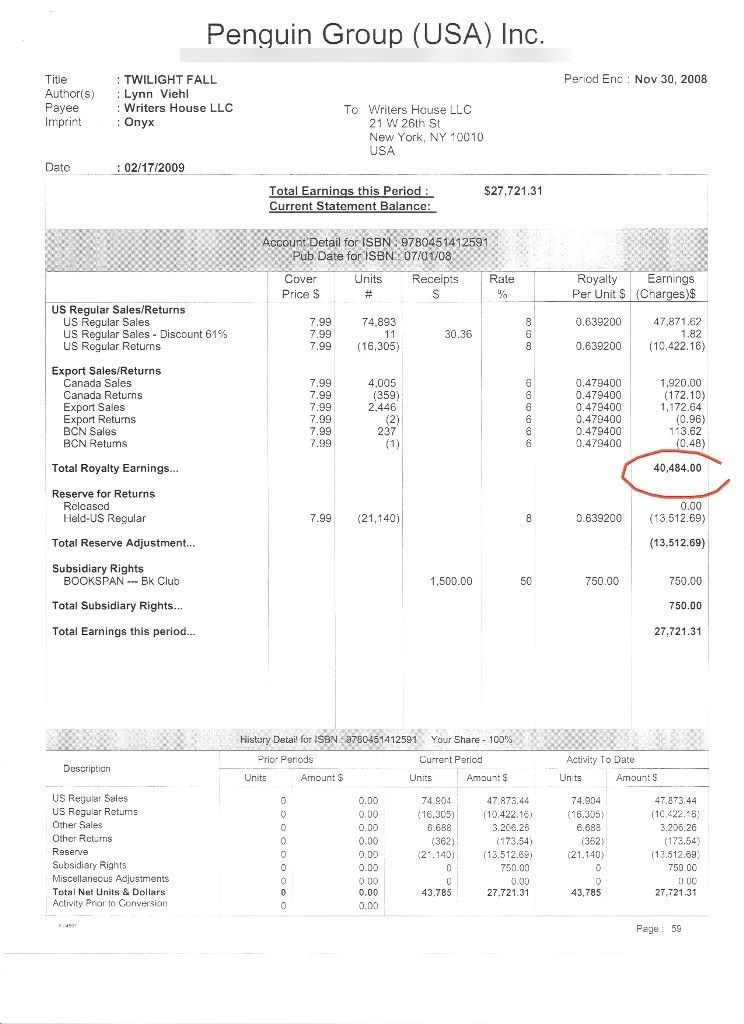
But it doesn't stop there. The publisher may have already been paid for the books that were returned, and they may have already paid the author royalties based on those purchases (or credited their account). When there are returns, they are debited from any future royalties that may be credited to that author's book. So, not only do returns cost the publisher money, but ultimately they cost the author, too. That is why it is imperative that both the publisher and the author do what they can to minimize returns. More often than not, when an author doesn't receive a royalty check for the quarter, it's not because their book hasn't sold. It's because they had returns. Returns are a black hole in which an author's royalties, and a publisher's profits, disappear.
New York Times bestselling author Lynn Viehl shared one of her royalty statements online to illustrate this point. You'll notice that her returns total more than $13,000 for this particular quarter. Her net earnings for the quarter were $0.
Returns will never be completely eliminated. No title sells out of every single copy ever printed. A return rate of 30 percent is considered "normal" in the publishing industry, but again, these returns cost you, the author, your hard-earned money. Publishers try to minimize these returns by not overstocking the distributor and by printing books in manageable print runs. Many publishers are switching to a "just in time" supply method of printing books as they need them to meet demand.
What can authors do to minimize returns and the damage they do to their royalty statements? Here are a few suggestions:
1. Do consignment events. Rather than do all of your book signing events at stores which order from the distributor, do a consignment event, where you provide the books that are being sold. You'll likely earn a higher profit margin, and the unsold books will go home with you, instead of back to a distributor.
2. Encourage the bookstore to order reasonable quantities. I have had authors get angry with a bookstore manager (and me) because the store only ordered a dozen books for their book signing event. They think the store should order at least 100 copies. The reality is the average bookstore signing sells about six copies. Guess what happens to the other 94 copies? That's right, they are returns, and another drain on your royalty statement.
3. Aim to sell out the store's stock at your events. Selling 6 copies at a book signing event might be a great boost to an author's self-esteem, but if the store ordered 30 copies the author actually lost money on the event. Try to find out how many books the store is ordering prior to the event, and then do your best to sell every copy they have ordered. If the store has ordered 30 copies, invite more than 30 people to your event. If the store sells out, that's fine. They can either place an order for the book through the store, or the store may invite you back for another event.
4. Target venues other than bookstores for signings and sales. A lot of these will either carry the books on consignment, or allow you to do a consignment event. Again, this will help you avoid returns.
5. Sell books on a non-returnable basis. Sometimes authors will hook up with a company or a church or some other organization and sell books to them in bulk. The company purchasing the books will typically get a larger discount, but in return they are purchasing them on a non-returnable basis, which means that sale won't come back to haunt you in the form of returns.
Book marketer Brian Jud once said "Bookstores don't sell books, they display them." That is true to certain extent. Nobody at the bookstore is actively pushing books on their customers. Customers browse and if they are interested in a title they may buy it. Or not. It is up to the publisher and the author to create the awareness and the demand to make the book-buying public familiar with a title. It is up to the author, not the store, to get people through the door for book signing events and to move books at those events.
Do your best to avoid returns, and that will be reflected on your royalty statement.
Saturday, February 20, 2010

Just out of curiosity, I checked Amazon recently to see which titles were the current bestselling titles offered by Tate Publishing (where I work as associate director of marketing). The Top 5 (at the time) were:
1. A Daughter's Worth: A Bible Study for Teenaged Girls
by Ava Sturgeon
2. What All Little Girls Need & What Most Women Never Had: Healthy, Loving Relationships with Their Fathers
by Joe Cucchiara
3. The Manufactured Identity
by Heath Sommer
4. Eden: The Knowledge of Good and Evil 666
by Dr. Joye Jeffries Pugh
5. How to Survive (and Perhaps Thrive) on a Teacher's Salary
by Danny Kofke
If you peruse these titles on Amazon, you'll notice that with one exception, they were released 3 to 5 years ago. That's right, 3 to 5 years ago. They aren't new releases which have raced up the Amazon sales rankings. The authors all have one thing in common: they have consistently and persistently worked to market and promote their titles.
As I have mentioned here before, too many authors give up on promoting their titles way too soon. In many cases, I have spoken to authors who are ready to throw in the towel 3-6 months after their book's release because the aren't seeing the kind of results or reception they thought they would get with their title. It has always amazed me that authors are so willing to give up on something in which they have invested so much time and effort.
Publishing is a competitive business. Last year, more than 560,000 titles were released in the U.S. That's more than 1,500 titles per day! What are you doing to make your title stand out?
I help market two of the titles in the Top 5, and I am somewhat familiar with a third title on the list. I know that these authors have done the following to raise the profile of their books:
They have made a number of media appearances. In the case of Dr. Pugh, she has scheduled numerous Internet radio programs for herself through BlogTalkRadio. This led to an appearance on the syndicated radio program Coast to Coast AM, and that led to her being invited to appear in a series on The History Channel called The Nostradamus Effect. She continues to do Internet radio interviews.
They are actively participating in author appearances and book signing events. These include speaking engagements and any other events where they might have an opportunity to discuss their book.
They have their own web site or blog. Most, if not all, of these authors have raised their online profile with their own web site, writing on their own blogs and participating on social media sites like Facebook or LinkedIn.
They didn't quit. Even three to five years after their books have been released, these authors continue to seek new opportunities to talk about and promote their books.
A couple of years ago, I remember seeing an ad in a publishing trade magazine in which the publisher was congratulating one of their children's book authors for selling 100,000 copies of their book. Wow, I thought, that's pretty good! Out of curiosity, I checked to see when the book had been released. I was shocked to discover it had been released almost 20 years ago. It had taken two decades for the author to sell 100,000 copies of their book, but they were still promoting it, and they were still selling copies of their book every year.
It is good to set goals for yourself each year about what you would like to accomplish with your book, but remember, it all doesn't have to happen within a couple of months of your book being released. Marketing a book is a marathon, not a sprint. Your book has no expiration date. It will have a shelf life for as long as you are willing to stand behind it.
Wednesday, February 17, 2010

Most authors have dreams of making their book an instant bestseller...seeing their book fly off the shelves of bookstores and selling their books to throngs of fans at book signings. However, the average signing at a bookstore results in about six copies sold. That's right, six.
But what if I told you it is possible to sell hundreds, perhaps even thousands of copies of your book without stepping foot inside a bookstore? Authors are doing just that...by selling their books in bulk.
I'm not talking about selling books out of the back of a truck, although that might work for you, too. No, these are sales directly to major companies which will use these books at premiums or "freemiums" for their employees and customers. A few examples:
1. If an author has written a book about personal finance and money management, they could approach a chain of banks or credit unions about the possibility of purchasing a quantity of books at a discount (probably 40-50 percent off the cover price) and giving those books to new customers who open a savings or checking account.
2. Perhaps the book is about time management, or leadership, or effective work habits. The author could approach major companies about purchasing a copy for every manager or employee in their company. If it's a large company, the quantities could number in the hundreds or thousands. Again, you would need to offer the books at discount.
3. If the book is educational in nature, such as a Bible study book, the author could develop a course to go along with the book and offer it to churches around the country. Of course, the book would be required reading for the course. You could develop the same type of strategy for books about money management, getting through a divorce, better communication with your spouse, etc.
4. If you do public speaking and you are active on the speaking circuit, but not yet getting paid for your speeches (or aren't commanding high fees yet), tell organizations that instead of charging for the speaking engagement, the cost of attendance is the purchase of your book, which of course is tied to the topic of your speech. Tell them their members are getting the "organizational discount" of 20 percent off the retail price. The books could either be purchased at the door by attendees or in bulk by the organization itself (you can sweeten the deal by offering a bigger discount if they buy in bulk). If they have 500 attendees at the speech, and your book's retail price is $10, you'll stand to make $4,000 off that speaking engagement if attendees buy books at the door.
5. If you have a book about dieting, try to partner with weight loss organizations or gyms. You could cross promote with the businesses by giving them books at a discount to give to their new customers for free when they sign up for a membership, and when you are selling books at other events you could agree to place a small ad for the gym or weight loss organization inside your book (a card some other type of insert would do). When customers sign up at the gym with that card, they would get a discount on the membership.
These are just a few ideas, but it gives you a starting point. Perhaps you have some similar ideas of your own, or you could develop some that would work specifically for your book. Instead of trying to sell a handful of copies to each retail store around the country, target a few large companies or organizations which will purchase your book in bulk by the thousands. It will require some sales skill on your part, and you will have to show the companies and organizations how YOUR book will benefit THEM. They must see value in what they are buying. For the authors that can strike these types of partnerships, the rewards can be great.
Saturday, February 6, 2010

It's a situation in which most new authors find themselves. Their book has been released, but it's just not flying off the shelves or climbing the sales ranks at Amazon.
"I thought this book would sell itself!" is something I have heard from several authors.
The truth is, no book sells itself. Authors sell books, with help (sometimes very limited help) from their publishers. We have already discussed how much competition there is in the publishing industry. So how does an author stand out from the crowd? With branding.
Everyone, regardless of what industry they are in, has a personal brand. Their brand is their personal reputation, how other people view them, and what they have come to expect from that person. Vikings quarterback Brett Favre has a brand. Coca Cola has a brand. Apple Computers has a brand.
There are plenty of pro football players, soft drinks and computers in the world. Hundreds, in fact, if not thousands. However, not all football players, soft drinks and computers are comparable. Some are better than others. Some have been around longer than others. Some have developed more of a following than others. They have developed this track record of success with branding. For example, when I go see a movie starring Sylvester Stallone, I can pretty much count on the fact it's going to be an action movie. When I read a book by Dean Koontz, I know it's going to be a thriller.
This blog is an effort to brand myself as someone who knows how to sell books. In the nearly four years I have worked at Tate Publishing, I have sold a LOT of books. That success didn't come overnight, and neither does developing a successful brand. So, how does an author go about developing a personal brand?
Identify your key strength. What makes you different from other authors? Do you specialize in a particular genre? What is your expertise? What makes your book different or more interesting than others? Make a short list of these qualities. These are the things that are part of your personal brand.
Develop a clear and concise message to communicate your brand. Burger King lets you "have it your way." Coke is "The Real Thing." Brett Favre is a "Superbowl champion quarterback." I promote "sales, service and success." These tag lines are all part of branding a personality, product or service. Once a person or a product becomes well-known enough, their name itself is a brand. Kleenex is a brand of facial tissue, but now everybody calls facial tissue Kleenex, whether it's actually made by Kleenex or not.
Persistently and consistently communicate your brand. Now that you have figured out your brand (you're a romance novelist who specializes in stories with twist endings, for example) you need a way to constantly communicate that message, and do it persistently. Michael Jackson always referred to himself as "The King of Pop," and after awhile everyone else called him that, too. Use many different communications channels to convey your brand. Your press releases, your news letters, your web site, your email signature line, your blog, your social networking pages...everything should contain your branding message. If your marketing materials contain your brand, then interviewers and book reviewers will start to use it, too.
Branding can be subtle. Not everyone has a tag line as part of their brand. Jeffery Gitomer writes a series of books about selling and positive attitude, and each of his books has a color in the title of the book. His best-known book is perhaps "The Little Red Book of Selling." When he appears at speaking engagements, he wears a red shirt. His own web site depicts him wearing a red shirt. He does have a slogan: "People don't like to be sold, but they love to buy!" In fact, he has trademarked that slogan.
"The Chicken Soup" series of books is perhaps one of the most well-known series of books around. Every book title in the series has "Chicken Soup for the Soul" featured prominently. "Chicken Soup" is part of the branding. You may not remember the names of the authors, but you will remember "Chicken Soup."
If you haven't given any thought to your personal brand, now is the time to start. Is your message in your marketing materials, web site and backmatter of your books clear and consistent? Can you somehow incorporate your branding into the elevator pitch for your book? Remember, your book is a business, and each successful business has a brand. What does your brand say about you?
You can learn more about branding at Brand-Yourself.com.
Tuesday, February 2, 2010

So, what's your book about?
It is one of the most common questions asked of an author, yet I have watched as many authors hem and haw and stumble their way through an explanation of their book...and these are the people who wrote it. It's not that they don't know what their book is about. Of course they do. My theory is that they don't want to brag about themselves, or their book, so they just give a very vague description. Others go completely the other way, taking an extremely long amount of time to describe all of the best plot twists in their book.
These authors don't have an "elevator pitch."
An elevator pitch refers to a very brief overview of a product (in this case your book) which can be described in 30 seconds or less...about the length of an average elevator ride. If you have ever seen the show "Shark Tank" (I prefer the British version, "Dragons Den" on BBC America), you have seen an elevator pitch in action.
Why should authors have an elevator pitch for their book? Think of all the times you might be asked to describe your book: book signing events, book fairs, radio interviews, meetings with bookstore managers, and you'll quickly come to realize it is a question you will get a lot. Your answer could determine if you get a sale or not.
The pitch for your book doesn't need to be long, involved or difficult. It does need to be able to pique the interest of people in a very short period of time. These pitches don't need to be (and shouldn't be) any longer than 2-3 sentences. Here are a few sample book descriptions taken right from the backmatter of a few well-known books:
"The Green Mile tells the story of two men, a prison guard and his new death row inmate, and their suddenly intertwined lives. What would it be like to walk those last 40 yards to the electric chair, knowing you were going to die there? What would it be like to be the man who had to strap the condemned man in or pull the switch?
The Green Mile by Stephen King
"A kidnapped daughter is presumed dead, and when her grieving father receives a letter, apparently from God, inviting him to the scene of the crime, he can't help but go. What he finds there will change his world forever. "
The Shack by William P. Young
After years of disagreeing about what true happiness, success, and love really are, Dave and Clarice Johnson finally face the breaking point of their marriage. When Clarice's leg is crushed in a car wreck, the obvious truth that more than just her injuries need immediate attention is finally exposed. Clarice and Dave struggle to find restoration as they learn the importance of promises made and kept - and the truth that help sometimes comes from unlikely places.
Not Easily Broken by T.D. Jakes
Each of these are wildly successful books, and in the case of The Green Mile, lengthy. However, these descriptions are brief, but capture your attention. Of course, you're not going to spout your book's backmatter when someone asks what it's about, but these types of descriptions give you a starting point.
In no more than three sentences, write down what your book is about. Imagine your book is a movie. If you were reading a TV Guide description of that movie, what would it say? Focus on the central idea of the book, but make sure you "tease" the reader. You want them to be just interested enough that they will say "I have to read that book and find out more!"
Now, re-write this description and make it conversational, like something that could come up in casual conversation. After you have done this, practice reciting it a few times. You want it to sound natural, not like something you have memorized.
You aren't going to commit this to memory word-for-word, but now you have a good general description of your book...your "elevator pitch." When someone asks you what your book is about, you will be able to describe it in a couple of sentences and in such a way that it will make that person want to know more. If they ask you more questions about your book, that's great! They're interested. I have been to some trade shows where I saw a couple of authors spend half an hour telling someone what their book was about. Not only did they not sell their book, but it's highly unlikely that poor soul whose time they wasted will ever bother to read it. Why should they? The authors already recited it to them.
Your book pitch will serve you well when you get out in public, do book signings and media interviews and when you get the inevitable question: "What's your book about?"
Thursday, January 28, 2010
- Terry
Authors Need to Think and Act Like Entrepreneurs
By Matthew Toone
If you are an author, or even an aspiring author, you probably realize that less than 1% of published authors ever make more than $50,000. The vast majority of authors are unsuccessful because they fail to realize that their book is a product and that authorship is a business. Authors often fail because they believe that writing the book is their responsibility, and promoting the book is the publishers. The first step towards guaranteed failure for most authors is to simply write the book, hand the manuscript over to the publisher, and expect the publisher to make them millions.
To put it simply, authors fail because they do not think or act like entrepreneurs! There is a 'secret' that most successful entrepreneurs know and apply that is the reason for their success. This same 'secret' or formula, ironically, is the same formula needing to be applied to be successful in anything in life. Unfortunately, most authors know of and practice only the first few steps, and then they unfortunately stop (or quit) by not putting into practice the last few steps of these secrets for success. To summarize this formula and apply it to authors (although it applies to anyone and any goal), we need to break it down into 5 simple categories:
1) Desire Success
2) Believe in Themselves and their Book
3) Take Action
4) Learn from Failure
5) Persist and Never Quit
The formula seems simple, right? The reality is that there is much more that goes into it, and it is certainly more difficult than these 5 simple steps make it seem. However, most unsuccessful authors stop after step 3. Every author of course desires their book to be successful, they undoubtedly believe in their book, and they put forth the necessary effort to write the book. However, writing the book is half the battle - promoting the book to make money is much more difficult. Thus, most authors fail because they expect or depend upon others to make their book successful, when those 'others' do not have the same desire, belief in the book, and time to put in the effort required to make the book a success.
Keep in mind that best-selling books are best SELLING. That does not mean they are necessarily the best written, most informative or helpful, or even the most entertaining books. Thus, if an author's book is not making money, rather than assuming the plot, size of the market, or front cover illustration or title is the problem - perhaps the actual problem is within - reflected in a lack of the author's desire, belief, and work ethic to make the book successful. Every successful entrepreneur (and author) understands that their potential and success is determined by them alone - not the publisher, not the customers, not the economy, not even the business/book idea. They also understand that work will be required every day, overcoming fear and doubt is a constant battle, getting up after failure is essential, re-adjusting the marketing plan is necessary, not giving excuses or expecting others to make them successful is understood, and persisting until their goal is accomplished is what they are committed to doing.
So, where is the manuscript for your book? Is it collecting dust on the shelf, is it already published and in print, is it just thoughts in your mind, or perhaps you haven't even discovered yet that it is in your mind? Regardless of where it is, the reality is that it can be a success if you personally learn and implement the laws of success to achieve greatness in anything. But never forget that the success of any book is not solely found in the plot, market size, topic covered, or catchy title - it is mainly found and realized because of the desire, belief, and work ethic of the author.
Matt is the founder of http://www.awakeyourpotential.com/ - a website focused on inspiring people to achieve their goals and dreams, live up to their full potential, and learn the secrets for success in anything. As a successful entrepreneur, Matt recently accomplished one of his dreams - to write a book! His book is entitled: "Great Games! 175 Games & Activities for Families, Groups, & Children." To view the book and learn more, visit: http://www.greatgamesbook.com/.
Article Source: http://EzineArticles.com/?expert=Matthew_Toone
http://EzineArticles.com/?Authors-Need-to-Think-and-Act-Like-Entrepreneurs&id=3558828
Saturday, December 19, 2009

Quick: without Googling it, which novel won the National Book Award for Fiction this year?
Chances are, you don't know the answer. I have to admit; I didn't, and I work in the publishing industry. I had to look it up, and the winner was announced just last month. Yet, many authors are convinced that book awards will help them sell thousands of copies of their book.
Do book awards really sell books? The answer is: it depends.
Each year, it seems that there are new book awards being created for authors to enter. The reason for this is that for many competitions, book awards make money for the organization sponsoring the award.
I can understand why an author would want to enter their book for an award. They are proud of their book, and they would like to be recognized for that work by their peers. However, don't confuse recognition with book sales. They are two completely different things.
Here are a few myths about book awards competitions:
1. "A book award will help me sell lots of books." I did some research on this, and found many quotes from the publishers of award-winning books which went something like this: "It's nice for the author to get a pat on the back with an award, but overall we didn't experience a sales increase." Also, many of the books that win major awards already have a good track record of sales at the time they win.
2. "A book award will ensure I'll be a bestselling author." If myth Number One isn't true, then this one can't possibly be true. There is no doubt that award-winning books have gone on to become bestsellers, but was it because of the award?
3. "A book award will help make my book become more well-known." If you didn't know the answer to the question I asked at the beginning of this post, is that really true? How many people browsing for books at your local bookstore specifically look for award-winning books? I don't, and I'm willing to bet you probably don't either.
Here are a few truths about books awards:
1. "I can incorporate my award into my marketing plan." Sure you can. You can include "Winner of the XYZ Award" in your press releases and on your book's web site. It sounds impressive, even if people haven't heard of the particular award your book has won.
2. Most people don't pay attention to book awards. Other than the major awards, such as the Pulitzer, most people outside of the publishing industry don't pay much attention to awards. This includes the person you are trying to impress the most: the one who buys books. Case in point: when I worked as a journalist, I won many, many news awards. When I first started winning news awards, I thought to myself, "This is it! I'm ready for the big time!" The fact was other than the radio station I worked for (and the ones I beat), nobody really cared.
Think of it this way: who won the Oscar for best actor this year? C'mon, almost everybody watches the Academy Awards, right? Besides, we're talking about movies. Everybody watches movies. Give up? It was Sean Penn for the movie "Milk."
3. "I can make some money by winning an award." This is true, but not in the way you might think. Many awards result in the winning author receiving some kind of cash prize. Even though the award may not sell a bunch of copies of your book, you could still get some money if you win.
Also, you have to be careful about which book awards competitions you enter. Some "competitions" are outright scams. Authors enter an awards "competition", send in an entry fee, and wait to find out if they won. There may not even be an awards committee or an awards ceremony. The person running the competition could be somebody who built a web site, came up with a name for an award, charged a $50 entry fee and got 5,000 entries, and printed 5,000 certificates for the "winners." Stick to established awards competitions from reputable groups.
Book awards aren't a bad thing. If you are an author proud of your work, by all means enter an awards competition, but keep in mind what book awards are not: a guarantee of increased book sales. There are no guarantees in the publishing industry.
By the way, the winner of the National Book Award winner for Fiction this year was "Let the Great World Spin" by Colum McCann, who was already a bestselling author.
Thursday, December 17, 2009
There are bookstores, of course, but we have already talked about the tremendous amount of competition there is for space on a bookstore shelf. That doesn't mean the author and publisher shouldn't try, it just means it shouldn't be the only focus of their marketing plan for a book.
Here are some sales opportunities that may not have occurred to you, and these are all locations which have worked out really well for the authors I assist.
1. Niche Marketing Venues. What is a niche marketing venue? Basically, any place where you would find the audience that would be most interested in your book. One of my authors has a historical fiction book about the Civil War. I told her the best venues for the book would be places like Civil War reenactments, Civil War museums, Civil War groups...any place related to the Civil War. During one of her recent 2-day evens at a Civil War reenactment, she sold $5,000 worth of books. Not bad for a weekend!
2. Coffee shops. Everyone thinks of Starbucks, but there are many other coffee shops across the country, and many of them also happen to sell books. These are good for novels, poetry readings, etc. Some of the most successful "store" book signings I'm aware of have been held at coffee shops.
3. Craft shows/bazaars/expos. Some of these events draw hundreds, if not thousands, of people. The trick here is to realize that people are not there to buy books per se, but they are there to buy. You can't just sit at a table full of books and expect them to sell. Dress up the booth, use a theme related to your book, do anything to draw attention to your booth. Children's books and novels do well at these types of events.
4. Gun shows. Got a book with a military, political or law enforcement theme? These sell really well at gun shows. People don't just go there to buy guns, and it's not just the guys that shop at gun shows. They usually bring their wives, too. Again, they are at these venues to buy.
5. Public service organizations. Groups such as Kiwanis, Lions and Rotary are located in just about every city, and they meet weekly. They are always looking for guest speakers at their meetings. If you can develop a presentation around your book, even if it's about to become an author or what it's like being an author, you can usually get invited as a guest speaker. If you do a great job, word gets around and clubs in surrounding areas may also invite you to speak at their meetings. Of course, you would hold a signing at the end of the meeting and sell your books.
These are just a few ideas, but you get the picture. If you can connect your book with the people that would be most interested in it, even if it's not in a retail setting, it can work out very well in terms of promotion and sales.
Give us your feedback: Which "unusual" locations have been good for your book sales?
Sunday, December 13, 2009

When an author first publishes their book, they have visions of walking into a bookstore on their book's release date...any bookstore...and immediately spotting their book on the shelf, right there at the front of the store. There may even be a stack of their books in a point-of-purchase display or in the window of one of the major book-selling chain stores. However, unless they are already a best-selling author, a celebrity or infamous (think Tiger Woods or Sarah Palin), this is highly unlikely.
But why? you might be thinking. My book is great! Everybody who reads it tells me how great it is! This may be true, but believe it or not, the decision to stock your book on the shelf has less to do with the merits of your book and more to do with mathematics.
In 2008, there were 560,626 new titles published in the U.S., more than double the number of books that were published just five years earlier. Most of this growth has occurred in self-published or short-run titles. However, despite the growth in the number of titles, bookstore sales are actually declining. Taking into account the number of titles available and the number of actual books sold, the average U.S. book is selling less than 250 copies a year.
When a new title is released, it isn't just competing for shelf space at bookstores with 562,626 other titles, it is also competing with the millions of other titles that have been published in previous years. For every spot available on a bookstore shelf, there are hundreds, perhaps thousands, of other titles competing for that one spot.
Don't just take my word of it. Most of this information was originally written by the president of another publishing company. As for the prime point-of-purchase displays at the front of a bookstore, publishers pay for that space, and that real estate isn't cheap. The major chain stores don't just put the books at the front of the store because they like them.
This information may seem a bit depressing for authors, but only for those that completely depend upon the major chain stores to sell their books. It isn't the fault of the bookstores. With so much at stake, the bookstore buyers must stock books that they feel will have a good chance of selling and making money for the store. A book by a new, unknown author is a gamble, and a big one, for stores that must turn millions of dollars in profit each year just to make payroll and stay in business. That means stocking a lot of titles by famous celebrity authors, or titles that already have a good track record of sales.
Pretend for a moment that you own a video store. Which movie titles are you most likely to stock? Blockbusters like "Twilight," or an independent film featuring unfamiliar actors? This is the same decision bookstores must make, and there are far more book titles released each year than movies.
This is the reason why niche marketing is so vitally important to authors and publishers. One fact I didn't touch upon earlier is that most book sales don't occur at bookstores. Most books are sold through other channels, such as retailers other than bookstores (supermarkets, pharmacies, gift shops, coffee shops), book clubs, online booksellers like Amazon, churches (many have their own bookstores now), home shopping TV channels, etc.
Of course, publishers do want their books to be stocked and sold through bookstores. Bookstores do, in fact, sell books. However, this shouldn't be the only marketing channel used by publishers and authors. Focus on the book's niche, figure out who the audience is for a particular title, and where that audience can readily be found, and you'll have identified your prime market.
Leave a comment answering this question: What have been the best markets for YOUR book?