Book Marketing, Author Publicity, Branding

Showing posts with label niche marketing. Show all posts

Tuesday, March 28, 2017

Identifying the Target Audience for Your Book


You have written a book, and now you’re set to launch your marketing plan and schedule a book tour, right?  Well, not so fast.  Have you considered who your target audience is for your book? 

One of the biggest mistakes that authors make is assuming that “everybody” will want to read their book.  No book is for everybody.  If you take one thing away from this particular article, keep that one at the front of your mind:  No book is for everybody. 

Books come in many different genres, and readers have their favorites.  I like to read non-fiction history books, while my wife likes to read romance novels.  If an author of a romance novel was trying to reach me as a member of their target audience, they would fail because I’ll likely never buy a romance novel (unless it’s a gift for my wife, but she only reads romances written by her favorite authors). 

Before I got into the publishing industry, I worked as a radio announcer.  The most successful radio stations I worked at were those that realized that not everyone who listens to the radio listens to their particular station.  People have their favorite types of music.  Someone who likes rock music isn’t going to listen to a country station.  Someone who favors rock of the 50’s and 60’s isn’t going to want to listen to a rock station that plays only 80’s hair metal.  With that in mind, the radio station targeted people of a certain age group. 

We even went so far as to find pictures of people from magazines who represented our “average listener” and taped them on the wall in the radio studio to help us keep in mind who the target audience was for our station.  At one station where I worked, we taped a photo of a soccer mom in her 30’s with a husband and two kids on the studio wall, because our research had shown that was the target audience for the type of music we were playing, and our advertising was aimed at that audience.  We didn’t try to please everybody with our radio station; just our target audience.

That is exactly the type of approach authors need to take before formulating their marketing plan for their book.  You can’t please everybody with your book; just your target audience. 

Yet, many authors decide that their book can’t or won’t be a success unless they are doing a book signing in a big box bookstore whose target audience is…everybody.  The problem is if you have written a historical fiction novel and only one out of 100 people who walk through the front door of the bookstore are interested in historical fiction, you aren’t going to move many books if you are only relying on the store's regular foot traffic. 

How do you determine the target audience for your book?  Let’s illustrate it this way.  We’ll assume you have written a novel about a family torn apart during the Civil War, and two brothers find themselves on opposite sides; one fights for the Union, while the other fights for the Confederacy. 

Initially, you may want to target everybody who buys books.  For our purposes, we’ll use this photo to represent the audience you may be tempted to target from the outset:


But, this may better reflect the number of people who are actually interested in historical fiction:


Going even further, this may be a more accurate portrayal of the number of people from this group who are interested in historical fiction that focuses on the Civil War:


If your marketing efforts are focused entirely on reaching everyone in the first photo, your message is going to fall on deaf ears.   Most of those people are not interested in a historical novel set during the Civil War.   You will be spending a lot of time, effort and energy trying to reach a massive group of people who aren’t receptive to what you are trying to sell them. 

You may interest a few people in the second photo, but again you will be wasting a lot of time trying to target people that are never going to buy a book like yours for as long as they have a nose in the middle of their face. 

If you identify your target audience, those folks in the third photo, and you are only spending your time doing the things that will reach them and let them know about your book from the very beginning, you are actually going to be a lot more successful.  These are the people that are going to attend your book signing events and speaking engagements, and more importantly…buy your book.  Not only that, but they are going to let their like-minded friends know about your book, too (if they really like it and want to recommend it).  In turn, those friends will then let their acquaintances know about the book, and so on and so forth until larger groups of people know about and are buying your book, but they are the RIGHT groups of people…those most interested in a book like yours.  They are your target audience, and your sales and exposure will grow with word of mouth among those in that target group. 

You may be thinking “If I target that huge mob of people in the first photo from the start, surely at least a few of them will be interested in my book.”   That may be true, but what if the people in the third photo are not among those in the first photo?  Any author who has participated in a sparsely-attended book signing event and sold 1 or 2 books can tell you that they would have much rather had everyone in the third photo (their target audience) walk into the event and buy their book than all of the people in the first or second photo walk through the doors of the bookstore and walk past their table without giving their book a second glance.   

Going after “everyone” in the book buying public is a lot like playing the lottery and buying hundreds or thousands of tickets, hoping just one or two of them might be a winner.  By focusing your efforts on the groups of people who would be most interested in the type of book you have written, you will basically be taking that lottery ticket money and putting it in a savings account instead.  While the potential reward of the lottery is much larger, success is elusive and rare.  Putting a few bucks in the bank may not guarantee a huge reward right away, but it will pay off consistently over time. 

Try this exercise for determining the target audience for your book.  First, draw an inverted pyramid on a piece of paper:


The top line represents the largest group of people who might possible be remotely interested in your book.  The second line is the genre for your book.  The third line is the particular subject of your book.  The fourth line represents the groups of people that might be interested in that particular subject, and the last and smallest line of the pyramid represents the exact type of person that might be interested in your particular book. 

Now let’s put the pyramid into practice, using a Christian book as an example:

1st line:  Christians
2nd line:  Bible study book
3rd line:  What the Bible says about grieving
4th line:  People who have experienced loss
5th line:  Someone who has recently experienced the loss of a loved one or is trying to come to terms with their grief. 

Using this inverted pyramid example, we can see that if we only targeted Christians, we’d be shooting for a very broad group of people.  This particular book is focused on the teachings of the Bible as it relates to grieving, and the target audience is people who are trying to cope with their grief.  If you start out your promotional efforts targeting only Christians, and not necessarily those interested in a Bible study book, particularly a person interested in reading books about coping with grief, you’ll miss your target and you’ll expend a lot of energy reaching out to the wrong readers. 

Let’s say the author of this book was only doing book signings at Christian bookstores, just hoping to catch a customer walking through the door looking for a book just like their grieving book.  They may sell a couple of books.  However, if that same author sent notices to local Bible study groups or grieving support groups to let them know about their book signing, more of those people walking through the door of the Christian bookstore may be looking for exactly that type of book.  Remember, you’re trying to reach the pointy end of the pyramid, not the wide end of the pyramid, at least at the beginning. 

The books that become hugely successful are those that start at the small end of the pyramid and work their way up.  That comes as word about the book spreads amongst the small target audience and up through the larger groups of people at the wider ends of the pyramid.

It may seem counter-intuitive to only reach out to smaller groups of people at first, but these are the people that are going to be most passionate about a book like yours.  They are going to be the evangelists for your book, and they are the people who are going to be spreading the word-of mouth that your book needs to be a success.
Share:

Thursday, April 26, 2012

Reader mail: Niche Marketing Success Story

Today's post is an email I received from an author in response to Mark Mingle's guest post:  Are We Having Fun Yet?  Lisa Y. Potocar is the author of "Sweet Glory."  Lisa's email is a great example of why authors must be intimately involved in promoting their book, and how targeting a book's niche audience can lead to success...and a lot of fun along the way! - Terry

Hi, Terry!

In reply to your blog today, “Are We Having Fun Yet?” I’m having a BALL!!!! Just to keep you in the loop, I’ve had at least 15 events since my novel’s release on January 31, 2012, and I’ve sold a ton of books out of my own stash—YAY! I’m having HUGE success with the public libraries and their book clubs and historical societies. And my greatest audience is adults versus young adults, for which my story is aimed.  

I’ve been hopping on every opportunity that comes my way, including a radio interview, a writing presentation for 4th through 6th graders (this I did free of charge and it was a HUGE success), and two blog interviews. This past Monday night I presented to a local historical society, and the board members were thrilled when I signed back over to them the $50.00 honorarium to help them preserve their building.

I’ve been bringing Billy Bear (3 feet in stature) dressed in full cavalry garb and some Civil War bunting with me everywhere I go—Billy alone attracts great attention, but his offer to answer a question for a free bookmark is adding to bringing the crowds. And everyone has been rewarding my passion for my subject and enthusiasm to present it with a purchase or two—sometimes three—once even five by the same person.

I have numerous contacts to make that have arisen from my various events, such as the Capital District Civil War Round Table, a Civil War reenactment and encampment event in Windham, NY, Carnegie Hall in Pittsburgh, PA, numerous public libraries, another blog interview, etc., etc. I’ll keep you posted!

So….you be the judge….am I having fun yet? I hope you’re having fun too!

Lisa Potocar, Sweet Glory


Share:

Sunday, January 22, 2012

Book Signings of the Rich and Famous

Every new author has an expectation of their book signing events.  It usually goes something like this:  they will be held in a major bookstore, with huge banners on display and a line of people out the door.  The bookstore will have ordered hundreds of copies of the book and have them on display in the front of the store where they can be seen as soon as customers walk in the front door.

In reality, a new author's first few book signings may be held in a small, local independent bookstore, or maybe even a coffee shop.  They'll bring their own books to resell.  They have to hang their own posters to promote the event, and if they don't promote the event ahead of time they may sell only a handful of books, or none at all. 

Every author has to start somewhere, and that is not always in a major chain bookstore. With the current state of the economy, many bookstores are only doing events for well-known authors with a track record of sales, reducing the number of book signing events they host, or not hosting book signings at all.  The number of bookstores is also declining, most notably with Borders going out of business last year.

 Successful, celebrity authors have also taken note, and you are just as likely to see them doing a book signing at a  library as you are to see them in a large bookstore.  Here is a sampling of events featuring some well-known authors: 

Mary Higgins Clark makes it a point of directly reaching her readers by doing book signing events at Wegmans grocery stores. 

Basketball superstar Kareem Abdul Jabbar is conducting a book signing during an event at All Saints Church in Pasadena, CA (pictured above).

Olympic skating star Kristi Yamaguchi is reaching her book's niche audience by doing a book signing event at an ice skating center.

Olympic bicyclist Lance Armstrong signed 750 books in one hour during an event at a bicycle shop.  

Former TV talk show host Regis Philbin did a book signing event at the Coral Gables Congregational Church.

Frank Calabrese Jr, author of the New York Times Bestseller "Operation: Family Secrets How a Mobster’s Son & The FBI Brought Down the Murderous Chicago Family" did a book signing event at Bella Luna Cafe, an Italian restaurant in Chicago.

Kristiana Gregory, bestselling author of the popular "Cabin Creek Mysteries" did a book signing event at Rembrandt's Coffee House in Eagle, ID.  In that neck of the woods she's also a local author. 

Of course, celebrity authors also do plenty of book signing events at bookstores, but the point is they aren't limiting themselves only to bookstores.  They are identifying the niche market for their books and doing book signing events at places where they are likely to find that audience. 

I have worked with authors who have sold hundreds of books at a single event, and the events were not held in bookstores.  Bookstores should be a part of every author's promotional plan, but they shouldn't be the only part of their promotional plan.  Think outside the bookstore now and then, and you may be surprised with the results! 
Share:

Thursday, January 12, 2012

The Book Marketing Snowball

I was recently speaking on the phone with a new author whose first book was just getting ready to go to print, explaining how book signings work, why authors do them, the importance of niche marketing, how distribution works, etc., when I got this question:

"Well, that's all well and good, but how do we get my book into Walmart?  They would sell a million copies of my book!"

I then explained that marketing a book is like rolling a snowball down a hill.  When it first starts rolling, it is a small snowball.   As it continues to roll down the hill, it gradually gets larger and larger.  By the time it reaches the bottom of the hill, it is significantly bigger than it was when it started. 

When a new, unknown author first becomes published, their book is the small snowball.  It may go unnoticed at first, but with persistent promotion it will continue to grow.  It may not grow as fast as the author wants it to, but in order to keep the sales and exposure going, the author and publisher must continue to keep pushing it down the hill.  If the author stops promoting their work, what happens?  The snowball isn't going to get any larger, and neither will the book sales. 

Many authors want to begin at the top of the hill with the big snowball, but they only have a big snowball if they have a large platform from which to launch their book.  Is the author famous?  Are they well-known in their state, region or even across the country?  Do they have a large following in their life or profession?  If not, then they are starting with a small snowball. 

You may have heard of the book "The Girls With the Dragon Tattoo" by Stieg Larsson.  It's a book that has been made into a movie, which is now playing in theaters.  The book wasn't published until after the author had died, and it was released in Sweden, Larsson's home country.  Nobody outside of Sweden had heard of Larsson prior to his book being published, but it won an award and was well-received in his home country.  A publisher in Great Britain took a chance on the book and translated it into English, renaming it from the original title, "Men Who Hate Women" to "The Girl With the Dragon Tattoo."  The book didn't sell. 

The British publisher resorted to giving away copies; leaving them in public places like bus stops where people would find and read them.  Like a snowball, word of mouth grew until book sales picked up and "The Girl With the Dragon Tattoo" became a success.  Eight years after it was published, the book is now a Hollywood movie. 

That is an extreme example of a small snowball rolling down the hill and becoming something very big.  Not every author will have this kind of success, but the journey will almost always begin with a small snowball.  If you keep pushing it, it will become something bigger.  You just have to keep pushing. 
Share:

Tuesday, February 8, 2011

Top 5 Reasons Niche Marketing Is More Important Than Ever

Today's guest post is courtesy of Jim Miller.  Jim also writes his own blog at http://aftertheinkdries.wordpress.com


If you’re satisfied with your book’s progress up to this point in its life, then you might not need to read any further. If you’ve been frustrated with your book sales, it might be because you’ve never seen the importance of niche marketing. I hear from authors all the time who believe that their book will sell if only X number of bookstores carried it.

The boxes of returned books I have in my office tell me otherwise.

Top 5 Reasons Niche Marketing Is More Important Than Ever

5) RETAIL STORES ARE STRUGGLING – Borders just announced a freeze on ordering new books. They are struggling financially, and that has forced them to make a move that makes them less competitive, which almost guarantees they will struggle even more. Barnes & Noble has been looking for a buyer off and on for the past year. The leaders at both stores have flirted with each other about a merger, which would mean more stores closing. These are the two largest bookstore chains in America! 

4) MORE BOOKS ARE SOLD ON AMAZON.COM THAN ANYWHERE ELSE – Think about why you buy a book on Amazon: because you heard about it somewhere else. Without a known name and reputation and without word-of-mouth, few people will buy your book on Amazon. Niche marketing is the only way to build your name and reputation and begin the ripples of word-of-mouth.

3) THE MORE EVENTS YOU HAVE, THE MORE AMMO YOU GIVE ME – Publishers have the greatest pull with bookstores, and with them scaling back and closing, all publishers are scrambling to figure out how to reach the masses. When you have an event for me to promote, the media are more likely to care. When that event is more about helping people than promoting your book, people are even more likely to care, and they are more likely to promote your book. And you get more sales. As a publisher, we believe in your message and in the work we’ve both done to package it. But readers don’t listen to publishers. They listen to other people who they perceive as able to help them.

2) NICHE MARKETING IS FUN! – Your book may have a wide appeal, but there is always a narrower niche that is looking for your book even if they don’t realize it yet. These are the people who are just like you. They love your stories, they laugh at your jokes, and once they get to know you, they will become your fans and evangelists. It is indeed hard to break the ice, but once you do, you will have a blast being around the people in your niche.

1) NICHE MARKETING IS THE ONLY THING YOU AS AN AUTHOR CAN CONTROL – You can’t control bookstores. You can’t control what people you’ve never met will buy. You can, however, control your efforts. The more you do, the more you expose people to your book and message. This is not about you; it’s about your message. Your book is the only thing in the world that contains your message, and you are the one to whom your message was given!
Share:

Wednesday, February 2, 2011

What to Do When Retail Fails

Today's guest post was written by Mark Mingle, who has more than a decade of experience in the publishing industry. - Terry


The book retail market has been met with some startling news in 2011.

Barnes & Noble laid off 45-50 employees at their corporate offices in New York last month. Borders is on the verge of closing 150 stores and will likely be filing for bankruptcy in an effort to reorganize.

So what are authors to make of this news? How will their books get "out there?"

Here are three steps authors should make to continue to pursue sales and visibility for their books as this climate is changing:

1) Don't depend solely on the retail bookstore market to be the primary outlet for book sales. Those days are gone, and if you plan for your book like a good small businessperson, you will pursue multiple revenue streams for your book. Publishers that rely solely on the retail bookstore market are closing their doors (as the retailers close theirs). Authors that want to survive must have a plan for keeping their book relevant and visible in the marketplace outside the traditional bookstores.

It is not enough to expect customers to come find your book in the sea of books at bookstores that are more often more interested in selling a handful of bestsellers and non-book gift items in their stores than they are supporting new authors and books. Authors must be proactive in finding their customer base and recognize that this base may not ever darken the door of a bookstore.

2) Develop an online presence for your book. More books are sold online now than in brick and mortar stores. If you are not engaging readers online, you are missing a vast and diverse market - and one that is right at your fingertips!

Start a blog, develop a Facebook Fan Page for your book, and have a video book trailer for your book. This allows you to visually and electronically interact with your audience worldwide. Follow influential people on Twitter, and become a vocal expert in your field. Develop your own following by letting others hear what you have to say, and draw them to your book and how it will benefit them.

3) Most importantly, ask and answer these questions: Where are you taking your book? How are you engaging potential readers? What is the target audience for your book, and how do you intend to get the book in their hands as a professional author?

If you are not considering the above questions and making a plan based around these ideas, you will likely be disappointed in how your book is selling in 2011. But if you step out into pursuing this kind of mentality, you will find your audience, sell more books, and you will have fun! As you move into this environment of finding your book's niche, this can also drive readers back into the retail market to some degree, so the visibility you create on the non-retail side actually creates momentum and sales elsewhere.

Pursue speaking engagements, book fairs, civic groups, and other pubic appearances. If you've written a book on parenting or marriage, start your own small groups or conferences in your community. If your book is about World War II, find historical societies or college history classes that would be interested in your perspective or research. The possibilities are endless, and you as the author can find much more control, success, and profits from sales.

Share:

Tuesday, December 7, 2010

So, What Good Is All This Advice, Anyway?

Well, it's official:  this blog is now more than a year old.  It's hard to believe that I have spent nearly 13 months writing this blog, dispensing book marketing and promotion advice.  I am actually a bit surprised by the number of readers I have gained, as well as the reaction I have received to many of the posts.  This blog has a diverse readership, ranging from new authors who have just published their first book to best-selling authors from major "name" publishers.  It has readers not only in the U.S., but also in France, Africa, Canada and Singapore.  It has been rewarding knowing that I have helped authors in their quest to promote their books.

But, have I?

The advice here sounds good, and it is based upon my experience marketing books.  The experience I have gained from the past five years of working for a publisher has been invaluable, and I pass this information along to help authors save a lot of time, money and frustration.  I have really enjoyed it. 

To put the advice I give into perspective, I thought I would include portions of actual emails that I and other members of the staff have received from our authors, along with the blog posts that reflect the advice apparently followed by the authors.  After all, seeing is believing.  I have omitted the names of the authors, but have not altered the content of the emails.

How To Schedule Speaking Engagements

"I have started calling area churches. I did stop at a few but they are closed during the week so I have come up with a new strategy. I am calling churches and then following up with a letter a week later if I haven’t heard from them.  The second church I called was an amazing experience, to say the least. I was able to speak with the senior pastor who also pastors 2 additional churches. He said that my call was an answer to his prayer!! He had been praying for something new and fresh to come along as his sermons were getting stale and he was tired of talking about the rich and the war; whatever that means. I met with him the following day and we spent an hour together talking. I was able to meet his wife. He wants me to come and do a 6 to 8 week ministry on surviving abuse on Tuesday evenings from 7 pm – 9 pm. He also took my book cover flyer and my info sheet and said he was taking it down to a District conference he was attending this past week. He thought my book was so timely that he wants me to share my testimony with all churches in the state! "


"A BIG HUGE THANK YOU for however you got me into Dallas Child Magazine!!!   i saw it on-line last night and was soooooooooo excited!  but today i received copies in the mail and you cannot even imagine how thrilled i am!!!!    as i told you before -- it has always been a dream of mine to have a book published -- but when i have looked through countless magazines i always thought "how cool would it be to have your book picked to be in one of these lists!"   and both dreams have come true!!!"


"Just returned from a fantastic event at Prairie Grove Battlefield.  Sold lots of books! Averaged $1,000 per day sales in the 3 day event.  Had so many returning customers who are now avid fans (that was fun!)"

Do you have any success stories based upon the information you have learned from this blog?  I'd love to hear them!  
Share:

Friday, September 24, 2010

The 12 Commandments of Selling Books at Book Fairs, Conventions and Fairs and Festivals

As with book signing events, your goal for fairs and festivals is to draw a crowd to your booth, sell books and “create the demand” for the book.

1.      Register for the event as early as possible
    1. Contact the event organizer
    2. Find out the cost of the booth or registration
    3. Register for the event and inform your marketing representative
2.      Spread the word about your appearance at the event
    1. Church bulletin
    2. Online newspapers free event calendar listings
    3. Free online listing at Craig’s List http://www.craigslist.org/about/sites.html
    4. E-mail  invitations to your address book
  1. Share expenses
    1. Split the cost of the booth with another author, if festival organizers allow booth-sharing
    2. Decorate the booth with a banner and tabletop posters announcing that the author is available to sign copies of books.  Make the booth as attractive as possible!
  2. Establish a family member or friend to help you during the event
  3. Items you will need for your booth:
    1. Books.  You will need to determine how many books you will need to have available for the event.  You can always keep extra copies in your car, if needed. 
    2. Giveaways.  Just like at trade shows, attendees are always looking for free items.  Have a supply of bookmarks, business cards and push cards on hand to help promote your book if people don’t buy a copy on the spot.
    3. Décor.  Most festivals will give you a table and a chair, and not much else.  Find out if you’ll need table coverings, a tent or awning (if an outdoor event), or a power supply for any video or audio needs you may have.  Also make sure you have pens and posters to advertise who you are and why you are there, preferably with a photo of your book cover on it.  You may even want to have a banner made for your book that you can re-use at future events.  You’re only limited by your imagination.
  4. Be prepared with conversation starters.
    1. “How did you hear about the event?”
    2. “Are you an avid reader?”
    3. “Do you live in the area?”\
    4. Have a one-minute pitch ready to go that tells people who you are and what your book is about.  Practice it so that it seems natural and not forced.
  5. Have a guest-book on your table for people to sign their name and e-mail address. By doing this at every event, you can create a large mailing list for e-blasts or newsletters about your book.
  6. Practice good booth etiquette.
    1. If you are sharing a booth, be considerate and polite to your fellow authors.
    2. Don’t complain to your fellow authors if the event isn’t going well and you aren’t selling many books.  Attitude is contagious! 
    3. Work out ahead of time how you will approach customers at the booth so you aren’t overwhelming them and pressuring them to buy books.
    4. Be friendly and approachable.
    5. Don’t just sit at the booth and wait for people to come to you.  Engage passersby in conversation and offer them any giveaways you may have.  Use the opportunity to tell them about your book.
  7. Arrive early, allowing plenty of time to set up for the event.

  1. Have book ordering information available in case you run out of books.   Business cards and push cards can be used for this purpose.
  2. Send a thank-you card to the organizer after the event. If the event was especially successful, send a letter of commendation to the event organizer.  They may ask you to be a featured author next year.
  3. Book early for next year’s event.
Share:

Thursday, August 5, 2010

How Stieg Larsson's Millenium Series Became Bestsellers

You have no doubt heard of Stieg Larsson's Millenium Series:  The Girl With The Dragon Tattoo, The Girl Who Played with Fire and The Girl Who Kicked the Hornet's Nest.  All three books have become bestselling novels.  All three books have been turned into movies in Larsson's native Sweden, with American remakes in the works.  Only one author in the entire world sold more books than Larsson in 2009, and he was the first author to sell more than one million e-books on Amazon. 

Not bad for a guy who died of a massive heart attack in 2004, before the books were published. 

Larsson wrote the books for his own enjoyment, after he came home from work every night.  He didn't even try to get them published until just before his death.  So how did a dead man become a bestselling writer and celebrated mystery novelist? 

Book signings were out, as were media appearance, obviously.  The publishers, both in Europe and in the United States, had quite a challenge.  How does a publisher market books released posthumously?  The answer:  niche marketing.

In Great Britain, the books were published by a small, unknown publisher.  They didn't take off or gain momentum for several years.  The publisher resorted to giving away the books.  In fact, they gave away more books than they sold.  They left copies in the back seats of taxi cabs, on trains, in public parks...any place where people might pick up a copy and start reading it.  The publisher was losing money on the book, and it was a big risk, but ultimately it was one which paid off.

The American publisher resorted to online marketing.  They reached out to bloggers who specialized in reviewing mystery novels, they gave away review copies to bloggers and members of online book discussion groups, they reached out to libraries...anything to generate word-of-mouth about the book.  It worked.  Before the book was even released in the U.S. it was generating considerable buzz.

These efforts could have failed if the books were average, but Larsson's characters and ability to ratchet up the tension in each novel have thrilled critics and readers alike.  There is a great lesson to be learned from these marketing efforts.  There is perhaps no book more difficult to market than one released posthumously by a relatively unknown author.  It didn't happen overnight, but targeted niche marketing made all the difference.
Share:

Sunday, August 1, 2010

How to Schedule Speaking Engagements

One of the most effective ways for authors to directly reach out to readers (and sell books to them) is through speaking engagements.  For some authors, this is their main means of moving significant quantities of their books.  For others, it is a way of not only generating book sales, but it is also a means of generating additional income through speaking fees.  Whether you are looking for speaking engagements as a way of promoting your book and selling books through back-of-the-room sales afterward, or you are striving to become a paid-for-play speaker, one of the most difficult questions for the beginning speaker is:  how do I get started?

For folks like Sarah Palin and Bill Clinton, it's easy.  They are already household names, and they demand (and get) hundreds of thousands of dollars for their speaking events.  For those who are not famous, at least not yet, they have to start somewhere.  That usually means speaking to local civic groups like Rotary, Kiwanis, Lions, Chambers of Commerce, VFW, American Legion, book clubs, writing groups, etc. 

To start with, you might consider forgoing a speaking fee and making a book signing after the speaking engagement part of your agreement.  Once you become more well-known and you are in demand, then you can start charging for your speaking engagements, AND holding a book signing during back-of-the-room sales at the end of the event.  Here are a few tips to get you started on the path to public speaking events:

1.  Work your contacts.  Are you a member of any groups or organizations?  Does your college have an alumni association?  Start working your own contacts.  These are the people who already know you.  Even if they don't have an immediate need for a speaker, they may be able to give you some leads.

2.  Work the phones.  Call your local Chamber of Commerce.  Call your local convention and visitors bureau.  Call your local Rotary, Kiwanis and Lions clubs.  They are almost always looking for guest speakers.  Even if you have a publicist, make these calls yourself.  The decision-makers who schedule guest speakers want to hear directly from the author, not a go-between.  Nobody can speak more passionately about your book or your speech topics than you. 

3.  Work on your flyer.  Try designing a decent one-sheet flyer that you can mail out to any organization that might have a need for a guest speaker.  Include a good author photo, a picture of your book cover, and a bullet-point list of your topics and why you would make a good guest speaker.  Don't make it read like a resume.  Concentrate on how you can help the organizations, not your past experiences (although you should have a very brief author bio).  Include some testimonials from anyone who has booked you as a speaker in the past.  You can see some examples of one-sheets here.

4.  Ask for referrals.  When you do a speaking engagement, always make sure you mention at the end of your talk that you are available for other speaking engagements.  You never know who is sitting in the audience.  Make some one-sheets available at your book signing table.  One speaking engagement could lead to others. 

5.  Create your own speaking event.  Book a room at a local community center or local public library and schedule your own speaking event/book signing.  It will give you a chance to practice and showcase your speaking skills, and could lead to other events.  An event of this type will require a lot of pre-promotion to get people in the door, so make sure you have something to offer that would attract people to your event.  If the first event is successful, you may be able to branch out to other venues around the area.  Before you know it, people have heard of you and they will seek out out as a guest speaker (always have business cards and contact info available at your speaking engagements).

6.  Join a Speakers Bureau.  You may have a local speakers bureau at the convention and visitors bureau or chamber.  Try to get listed on them, and you'll have prospects come to you.  This is most effective after you have already developed a reputation as a speaker.  Speakers bureaus usually take a percentage of your speaking fee for sending speaking engagements your way.  There are also online speakers bureaus (such as Speaker Leads, which is FREE for Tate Publishing authors) where you can be listed.
Share:

Thursday, July 29, 2010

The Magic of Niche Marketing

I have spent a lot of time on this blog talking about why niche marketing is so important to authors.  The publishing industry is awash in new books.  Last year, more than one million titles were released.  It's not enough anymore for an author to hope their book gets carried in every bookstore nationwide or that they will get a book review in Publisher's Weekly.  Authors need to reach out directly to the specific audience that would be interested in reading their book, and niche marketing is the key to making that happen.

Earlier today, I was meeting with one of the authors I work with, and he mentioned that he was a bit disappointed in the results of his book signing events, which have mainly been held at bookstores.  He sells anywhere from 4-6 copies of his book at each event, which is actually the number of books that the average bookstore signing sells.  His book is for a very specific niche audience, and I mentioned that speaking engagements and events at local public libraries might actually be more productive.  He could either do five bookstore events and sell 25 books, or do one niche event and sell the same number of books.  A light went on in the room, and he immediately saw the value of niche marketing.

More well-known authors are also jumping on the niche marketing bandwagon.  Forbes.com featured their work in an article called The Magic of Niche Marketing for Authors.

* Erica Bauermeister posted recipes to her blog as if they were written by the characters from her novel, The School of Essential Ingredients.

* Garth Stein reaches out to fans at NASCAR events to promote his book, The Art of Racing in the Rain.

* Abby Stokes, author of Is This Thing On? attends computer user conferences to promote her book for the computer illiterate.

These are some great examples, but I thought I would also add a couple my own, using some of my authors as examples:

* Nancy Dane, author of the Civil War-era novels Where the Road Begins and A Difference of Opinion, sells copies of her books at Civil War re-enactment events and museums.

*  J.A. Sanderlin, author of Europa:  Book One of The Black Chronicles, has found a receptive audience for his Sci-Fi book at comic book shops.  He will be participating in the Austin Comic Con this Fall at the Austin Convention Center.

What is the target audience for your book?  Where would you find members of this audience outside of the bookstores? 
Share:

Tuesday, March 16, 2010

A Great Example of Authors Targeting Their Book's Niche Audience


Chances are, you have never heard of the book Hell Hawks!: The Untold Story of the American Fliers Who Savaged Hitler's Wehrmachtby Robert F. Dorr and Thomas Jones. It's definitely a niche book, probably of interest mainly to aviation enthusiasts and World War II history buffs. It has also sold more than 24,000 copies in less than two years. Incredibly, half of those sales have been made at one bookstore. That's right: one store.

According to Publisher's Weekly, that bookstore is located in the Udvar-Hazy Center in Washington D.C., which is affiliated with the Smithsonian National Air and Space Museum. The items that can't be displayed at the main center are located at the Udvar-Hazy Center.

Dorr's first book signing at the center's bookstore sold about 12 copies, but since then he has done 330 more signings at the same store. Talk about targeting a book's niche market! The bookstore at the center typically orders about 1,000 copies of Hell Hawks! each month, and Dorr sells about 120 copies at each signing.

According to the PW article: "Dorr attributes his success to his strategy of "engaging people, getting them interested." He greets store customers, introducing himself by name, before discussing the book, and scrupulously avoids small talk that may distract him or the customer from the book. "The instant I decide the person is not interested, I move on," he added."

There are a number of lessons authors can learn from Dorr:

1. Targeting a book's niche audience is critical.
2. A book doesn't have to be available in every bookstore in the country to be successful. A few targeted stores which fit a book's niche will do.
3. Authors must be intimately involved in pushing their book.
4. Every author has to start somewhere. Even if the first few signings don't sell a lot of copies, don't give up.
5. Authors must engage customers at book signings. Just sitting at a table and waiting for customers to come to you will not cut it.

Be sure to check out the original Publisher's Weekly article.
Share:

Sunday, February 14, 2010

The 10 Terrible Truths of Book Marketing


During the time I have worked in the publishing industry, I have heard a lot of different ideas and statements about how to market books. Some of them are pretty good. Others might seem like a good idea to someone new to the industry, but in actuality they don't work at all. Those are the ideas I'm going to address in this post, but only because they come up so often. I probably hear these ideas or comments on a weekly basis. So, here they are, in no particular order: The 10 Terrible Truths of Book Marketing, along with the marketing requests or comments which generally accompany them.

1. My book will sell itself. No book sells itself. Selling books happens to be a lot of work, but it can also be a lot of fun. But no, books do not sell themselves. If they did, I wouldn't have a job.

2. Celebrities will help me sell my book. I have had requests to send review copies to President Obama, Joel Osteen, Sean Hannity and Larry the Cable Guy, among other celebrities. I'm not sure what authors think these people are going to do with their books, and I think President Obama has his hands full without taking on a book marketing project (other than his own book). Besides, most celebrities are more concerned with selling THEIR books than that of another author.

3. I'm an author, not a book salesman (or salesperson). Well, of course you're an author first, but along with that title comes a certain responsibility to help promote and sell your book. For some authors, this means doing book tours and making media appearances. For others, it means speaking to Rotary Clubs and eating rubber chicken dinners at speaking engagements. But make no mistake, authors must be involved in promoting their book, or it will collect dust on the shelf.

4. (From children's book authors) Let's sell my books through Scholastic Book Fairs. They sell a lot of books. Yes, Scholastic Book Fairs do sell lots of children's books...millions of dollars worth each year, in fact.  But, if you and your book aren't known and already have some kind of track record of sales, your book is less likely to be picked up by Scholastic. 

5. If I could just get on Oprah (or some other national TV show) my book will be a bestseller. I have worked with authors who have been on numerous national TV shows. There is no denying it is fantastic exposure, and it's the kind of exposure I work toward for my authors every day. However, making one appearance on a TV show does not guarantee bestseller status.

6. If we buy an ad on (Facebook, YouTube, Drudge Report or some other web site) my book will sell thousands of copies. Millions of people use these sites. It is true that these are high-traffic sites, attracting millions and millions of users. But hits on a web site don't necessarily transfer into sales. Think about it: when is the last time you purchased something as a result of seeing an ad for it on one of these sites? If you're like most people, the answer is probably "never." If you do sell a few copies, it is unlikely you would make back the amount of money spent on the ad. Even after I tell people this, they still insist on spending the money, only to later call and tell me they shouldn't have done it.

7. I'm just going to set up a web site and sell all of my books online. Having a web site should certainly be a part of any author's marketing strategy, but it's only one part of an overall strategy. Authors should also use other social media sites, do book signing events, niche marketing, media appearances, etc. One web site alone won't help an author sell a lot of books.

8. My book appeals to everybody. Unfortunately, no book appeals to everybody. Take a look at the New York Times bestsellers list. I'll bet there are books on that list you have no interest in reading. This is why it is crucial to specifically target your book's niche market.

9. Once my book is released, I'll be able to quit my day job and work at writing full time. This is every author's dream, but unfortunately few writers are able to make a full time living from doing nothing but writing. Many of them have day jobs, teach writing courses, teach book marketing courses, take freelance writing jobs, write for newspapers or magazines, etc. Most authors make $1-$2 in royalties for every book that is sold. If they received an advance, they don't receive those royalties until the publishing company sells enough books to recoup the advance. In those cases, it could take years for an author to see their first actual royalty check, if they get one at all. If a book isn't a success, the advance may be the only cash an author receives for their book. If authors can't purchase books from their publisher at a steep discount for resale, they may be waiting a long time to see any real money from their book.

10. If my publisher believed in my book, they would spend a lot of money to market it. The fact is, your publisher has already taken a chance on your book by agreeing to publish it. They have already paid for editing, layout, cover design, printing, distribution, shipping, and marketing. However, not every title gets a big ad budget. In fact, few books get ad budgets, period. These are usually reserved for authors who already have a reputation for producing books that sell. These are authors who have a platform, a fan base that wants to read the books that they write. Now more than ever, publishers are depending upon authors to deliver the fans that will buy their books.

In most of these instances, there is a belief or a misconception that if the author or publisher "just did this ONE thing, the book would REALLY take off!" What I'm trying to convey with this list is there is no magic bullet when it comes to book sales. There is no "one thing" that will deliver the sales the author wants. It takes a lot of things: hard work, persistence, patience, and of course, writing great books, to achieve success in the publishing industry. So tell everyone about your book, consistently promote it, work hard, don't give up, and great things CAN happen!
Share:

Thursday, December 24, 2009

What's It REALLY Like to be a New York Times Bestseller?

Most authors aspire to become a "bestselling" author. What exactly does this mean? You might think it means that your book has sold millions of copies and that it nets millions in royalties. The reality, however, is quite different.

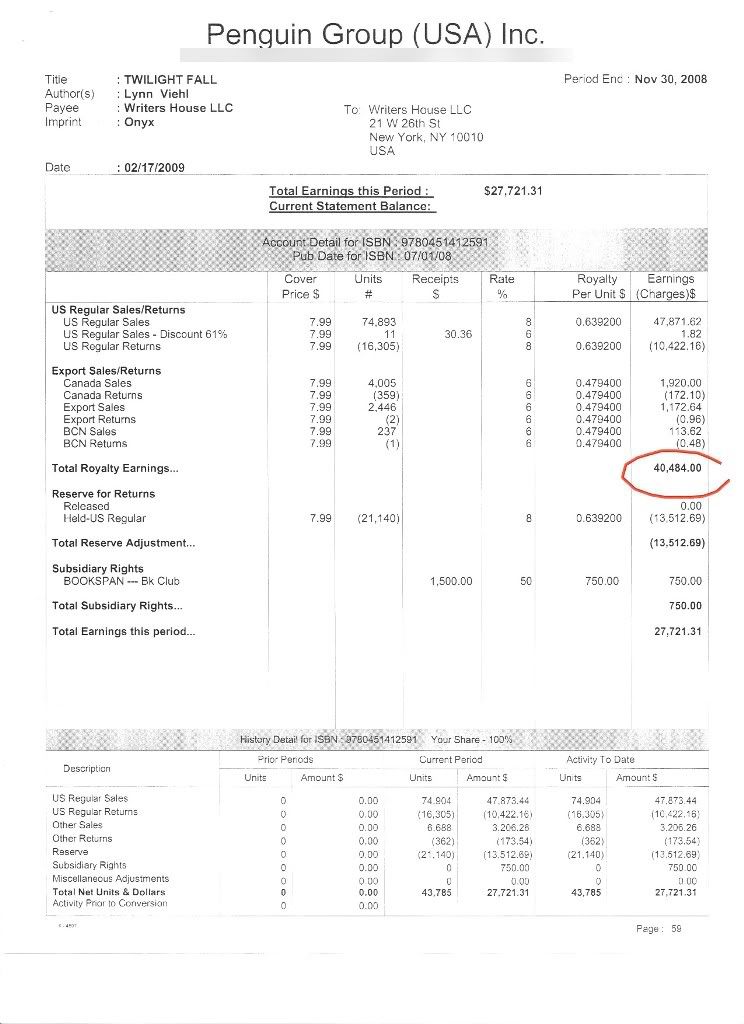
Sheila Kelly, also known as Lynn Viehl, is a New York Times bestselling author, and she blogged about the reality of hitting the NYT bestsellers list.

Her first NYT bestseller for mass market fiction was actually the sixth novel in The Darkyn series of books. She does a great job of breaking down how many books were printed in the publisher's initial run (not all publishers have print runs. Those are mainly used by those who use offset printing), the amount of her advance and how much she made in royalties during the period her book became a bestseller. She even posts a copy of her royalty statement.

Here are the highlights:

1. Her publisher did no marketing for her book. The author had a platform based upon previous books she had written, and she reached out to her readers. Her readers made her book a NYT bestseller.

2. For the royalty period that the book became a bestseller, it sold about 65,000 copies.

3. The author's royalties for that period were about $40,500. However, her net earnings, after returns, royalty holdbacks, etc., were just under $28,000. Her ACTUAL earnings for the period (because she had received an advance) were $0.

That's right, a NYT bestselling author sold about 65,000 books and didn't receive a royalty check. Now, once her title earns back the amount of her advance (IF it earns back the amount of the advance), then the author will start to see some royalty checks. But until then: nothing.

Kelly said most authors are lucky to make 10 percent profit on their book, and the amount of money she received for her effort up to that point (the blog post was written in April) was a grand total of $26,000. Many authors might say they would be happy to make $26,000 on the sales of their book, but remember, Kelly writes for a living, and this is a NYT bestselling book, after all.

I think Kelly shatters a few myths with her post:

1. Not all NYT bestselling authors are millionaires.

2. Not all NYT bestselling books sell millions of copies.

3. Not all bestselling authors have nationwide book tours.

Kelly's "secret" to sales success: connecting with her readers and reaching her book's niche audience.

As an author, what surprised you most about Kelly's post?

Share:

Monday, December 21, 2009

Five Recommended Marketing Books For Authors

I get involved with authors when their books are ready to go to print and receive their release date. When I make my first introductory phone call to the author, one of the most common things I hear them say is "I love writing, but I don't know a THING about marketing books." Sure, I'm there to help the author and assist them with the marketing and promotion of their book, but authors must be involved in the marketing of their book. No matter who the publisher of the book is, authors are always an important part of the marketing equation. Some publishers are bluntly telling their authors they are responsible for doing most of the heavy lifting when it comes to marketing their own book. Authors need to be savvy about publishing, the marketplace, and how to promote themselves. With that in mind, I have a list of five books that I consider required reading for authors who are looking for an edge when it comes to promoting their own books.

1. Amen: A Simple Guide to Self-Marketing Your Christian Book - I have had the pleasure of sitting in on one of Leon Mentzer's presentations for authors about self-marketing. Even though I have been in the business awhile, I learned some new things myself. Leon condenses his knowledge about marketing and promotion into this book, which could be used by any author, not just authors of Christian books. Leon's mantra: "I just concern myself with selling one book at a time."

2. 1001 Ways to Market Your Books - I purchased a copy of this book, read it cover-to-cover, and then one of my co-workers "borrowed" it and I haven't seen it since. I can't blame them. There is a lot of great advice in this book, and you're sure to find some marketing ideas you hadn't considered before. In my opinion, this book is really written with the self-published author in mind, so some of the book's advice won't apply to every author, but there is a lot of good info in this book that can be used by any author.

3. Beyond the Bookstore: How to Sell More Books Profitably to Non-Bookstore Markets - If you're looking for a good resource about niche marketing for books, this is it. Brian Jud points out the many lucrative markets that exist for authors outside of regular bookstore channels. The book even includes a CD-rom to help authors map out a marketing plan for their book using niche marketing channels.

4. Guerilla Marketing for Writers: 100 Weapons to Help Sell Your Work - This book is straightforward and blunt, which I like. "Guerilla Marketing for Writers" states that writers need to take the future of their book sales into their own hands, and it details several ideas to help writers move copies of their book. Many of the ideas in the book are free for the author to implement. If you want to sell books, you'll want to buy this one.

5. Social Media Marketing for Dummies - It's a fact of life; If you want to market your book these days, you need to know something about social media. Blogs, Facebook, Twitter...they are all being used by authors and publishers as a means of marketing and promoting their books. Social media works, but only if it is done well and done right. This book is a good crash course about how to use social media to your advantage for marketing and promotion.
Share:

Thursday, December 17, 2009

Book Sales Opportunities You May Have Overlooked

During my last post, I pointed out some ways of how NOT to sell your book. These are ideas that have been tried, and in my experience, really don't produce results. Some of my readers then asked, "OK, so where SHOULD I sell me books?"

There are bookstores, of course, but we have already talked about the tremendous amount of competition there is for space on a bookstore shelf. That doesn't mean the author and publisher shouldn't try, it just means it shouldn't be the only focus of their marketing plan for a book.

Here are some sales opportunities that may not have occurred to you, and these are all locations which have worked out really well for the authors I assist.

1. Niche Marketing Venues. What is a niche marketing venue? Basically, any place where you would find the audience that would be most interested in your book. One of my authors has a historical fiction book about the Civil War. I told her the best venues for the book would be places like Civil War reenactments, Civil War museums, Civil War groups...any place related to the Civil War. During one of her recent 2-day evens at a Civil War reenactment, she sold $5,000 worth of books. Not bad for a weekend!

2. Coffee shops. Everyone thinks of Starbucks, but there are many other coffee shops across the country, and many of them also happen to sell books. These are good for novels, poetry readings, etc. Some of the most successful "store" book signings I'm aware of have been held at coffee shops.

3. Craft shows/bazaars/expos. Some of these events draw hundreds, if not thousands, of people. The trick here is to realize that people are not there to buy books per se, but they are there to buy. You can't just sit at a table full of books and expect them to sell. Dress up the booth, use a theme related to your book, do anything to draw attention to your booth. Children's books and novels do well at these types of events.

4. Gun shows. Got a book with a military, political or law enforcement theme? These sell really well at gun shows. People don't just go there to buy guns, and it's not just the guys that shop at gun shows. They usually bring their wives, too. Again, they are at these venues to buy.

5. Public service organizations. Groups such as Kiwanis, Lions and Rotary are located in just about every city, and they meet weekly. They are always looking for guest speakers at their meetings. If you can develop a presentation around your book, even if it's about to become an author or what it's like being an author, you can usually get invited as a guest speaker. If you do a great job, word gets around and clubs in surrounding areas may also invite you to speak at their meetings. Of course, you would hold a signing at the end of the meeting and sell your books.

These are just a few ideas, but you get the picture. If you can connect your book with the people that would be most interested in it, even if it's not in a retail setting, it can work out very well in terms of promotion and sales.

Give us your feedback: Which "unusual" locations have been good for your book sales?

Share:

Wednesday, December 2, 2009

The Importance of Niche Marketing

When it comes to marketing and promoting your book, do you use a shotgun or a rifle? I'm not really talking about firearms, of course. I'm talking about the approach you use to marketing your book.

Many new authors make the mistake of trying everything under the sun to try to promote their books. Even though their book may only appeal to a very narrow, particular audience, they throw everything against the wall to see what will stick. They'll buy ads in newspapers, send out hundreds of review copies to publications which have nothing to do with the topic of their book, schedule book tours for themselves, and send emails to the Oprah Winfrey show. Some of what they try may work, but for the most part they are expending a lot of energy marketing their book to everyone and anyone, but not to the audience that would be most interested in it. They are using a shotgun approach.

The authors who use the rifle approach know the niche audience for their book. They do their research and identify the appropriate venues for book signing events and the media outlets that would likely be most interested in the topic of their book. If an author has written a book about figure skating, for example, they might consider scheduling book signing events at ice skating rinks during figure skating competitions and events. Such events draw hundreds, sometimes thousands of people, and it's probably a safe bet that the folks attending the event are somewhat interested in figure skating. Reaching such a large, pre-qualified audience sure beats sitting in a bookstore for three hours hoping that figure skating fans will wander in through the front door.

The approach to marketing depends upon the book, of course, but no book is for everybody. Even "Going Rogue" by Sarah Palin, which has sold more than 2.7 million copies, isn't for everybody. Even Palin's book has a niche: conservatives who more than likely voted for her ticket in the last election.

When you're planning your future marketing and promotion efforts, consider using a rifle instead of a shotgun. You may be very pleased with the results!

Question: What have you done to reach out to your book's niche market?
Share:

Don't miss a post! Subscribe for updates!

Enter your email address:

Delivered by FeedBurner

Web Hosting

Popular Posts

Copyright © Book Marketing for Indie Authors | Powered by Blogger

Design by ThemePacific | Blogger Theme by NewBloggerThemes.com | Distributed By Blogger Templates20