Book Marketing, Author Publicity, Branding

Tuesday, June 1, 2010

Are You Sabotaging Your Book?


Who would sabotage their own book? Authors don't do it intentionally, of course. But, when it comes to marketing their books, authors sometimes do things that could impede their sales, and take what could have been a successful title and relegate it to the bargain table of the local bookstore. Here are a handful of things I have seen authors do that get in the way of sales and success:

1. They give up too early. Authors sometimes spend years writing their books, only to throw in the towel on marketing and promotion after a few months. There is a lot of competition in the marketplace. In fact, last year there were more than a million book titles released in the U.S. Most books don't fly off the shelves of bookstores. It takes patience and persistence (and a lot of hard work) to promote a book, and the author must be involved. No publisher can guarantee book sales, but if the author quits too early I can guarantee the kind of results they will experience. My recommendation is don't quit at all.

2. They expect the book-buying public to beat a path to their door. This isn't true of any author, not even the famous authors. They had to start somewhere, too. Almost every successful author has a rags-to-riches story. They didn't start their writing career being famous, and many slaved away at it for years before they started to reap the fruits of their labor. Too often, authors show up for their book signing events and just sit at their table, waiting for a line of people to form, eager to buy the book and get the author's signature. More often than not, there is no line of people at the table, only customers walking into the store and avoiding eye contact. It is up to the author to engage them.

3. They get "Ernest Hemingway Syndrome." Getting a book published is great, but it doesn't mean the author automatically has the key to fame and fortune. Some authors adopt the attitude that now that they have a book in print the world owes them something. They get angry with bookstore managers who don't schedule them to come in for a book signing event, they get angry with the publisher if they feel their royalty checks are too small, they get angry with media outlets who pass on publishing a story or review about their book. There are NO guarantees in the publishing industry. Rejection is part of the business, and every author has experienced it at some point. The old saying "you'll get more flies with honey than vinegar" is especially true in the publishing industry. Nobody wants to help an author who is too demanding.

4. They don't have a plan. Too many authors expect other people to sell their books for them. Ironically, these are also the same authors who don't sell many books. Even the large publishing houses expect authors to come to the table with something in terms of marketing their book, whether it be a large fan base, a platform from which they can successfully launch their book (such as a popular blog or radio program) or a plan for reaching their target audience. Expecting your book to be stocked in every bookstore in the country is not a marketing plan. If an author doesn't have an idea for who the target audience is for their book, they are going to struggle to find an audience. Authors who know who they have written their book for and how they are going to reach that audience are always a step ahead in the game.

5. They don't listen to professional advice. On the other hand, some authors feel their plan is the ONLY plan which will work at all. They hire a publicist, only to micromanage everything the publicist does to the point of making their efforts ineffective. I once worked with an author who hired an outside publicist, and then proceeded to argue with the publicist every step of the way through marketing. The publicist resigned after a month. Publicists and publishers are the experts and the professionals in the publishing business. Many of them are very good and know what they are doing. Try following their advice now and then and you may be surprised at the positive results. You wouldn't hire a doctor to perform open-heart surgery and then proceed to disagree with him about how he planned to perform the operation, would you? Yet, some authors with no prior experience in publishing will vehemently oppose a publisher's or publicist's marketing plan without first giving it a chance. The professionals who are good at their job will explain what they are doing, and why, each step of the way through the marketing process, and work as the author's partner. If they don't, ask.

These are just a few examples of how an author can sabotage the marketing of their book. Writing a book is a labor of love, but selling a book is business. Approach it as a professional, surround yourself with good people, work hard and treat it as a job (it is) and you'll be giving your book the fair shake it deserves.
Share:

Monday, May 24, 2010

Guest Post: Being a First Time Author and Selling Books - A Dose of Reality


Being a First Time Author and Selling Books - A Dose of Reality


Being a First Time Author and Selling Books - A Dose of Reality

By Lynn Baber


It seems that almost every person I meet has either written a book, is thinking of writing a book, or has been told by someone that they should write a book. While I am not technically a first time author, it's been so long since the last one that I don't think it should count against me. Certainly very few people can remember that business book published way back in 1989.

Authorship is Glamorous, Right?

The news reports of book events by authors Sarah Palin, Sean Hannity, and Karl Rove have been making headlines in recent weeks. Their books were published, hit Amazon, and these authors garnered even more fame, money, and celebrity as each scheduled book event drew to a successful close.

"If only I could get my novel published, I could buy that house in the country," one would-be author laments. "Once my work is out there I can quit my office job and stay at home and write," dreams another. All I need is a break, and it's New York Times Bestseller List here I come!

Well, they're right, aren't they?

Nope. That is, of course, unless you already have a built-in audience numbering in the millions just waiting to part with $24.95 for a chance to meet you and get your autograph. If that doesn't describe you, then let me share the facts - just the facts, ma'am.

Publishing a Book is Like Buying a Horse

Not everyone who wants a horse will be able to buy one. Not everyone who has a story will get published. What is common in both the horse and book scenarios is that the upfront cost is the easy part. Once you bring your dream horse home the serious bills begin to mount and the real work begins.

Ditto publishing a book in today's market. Last year there were nearly a million book titles published if you add up the numbers from traditional publishers, self-published books, and e-books. I've seen reports that a successful book in the marketplace today is one that sells 5,000 copies.

Do you know how hard it is to sell 5,000 copies? We'll get back to that in a moment, first let's talk about the fun stuff - the money.

Authors who are published by traditional means are usually paid by royalties. Contracts differ among publishers and authors, but for the sake of argument let's assume you will receive a royalty of 15% of the price the publisher receives for books sold into the marketplace. Please note, your royalty is not 15% of the cover price, but calculated on the amount the publisher receives per copy.

Authors Make Millions

I suppose some do, just as there are folks who win the Lottery. Writing a book and buying a lottery ticket are both bad bets upon which to budget. Just for fun, let's assume your book is one of the few that actually sells 5,000 copies. If your publisher puts a cover price of $19.95 on your book it is entirely possible that the amount received per book will average around eight bucks, more or less. Don't get caught up in details until we wade through the concept part. So, if all 5,000 books are sold and not returned (did I mention that sold isn't always really sold...) the gross amount to your publisher is about $40,000. Congratulations, you are a successful author. Now let's look at your paycheck.

Don't call the realtor yet, your gross royalties amount to $6,000. I won't speculate on what it might cost you to write your book, but I know my office supply store clerk grins every time I come in for more paper and printer ink.

If you're still hankering to get your story or message out, maybe it's time to move on to the issue of marketing; actually selling books.

Selling Books Is Personal

The only way to sell books is to tell your story to the people who are interested enough in the details to write a check, hand over cash, or hover their computer cursor over the BUY NOW button and left-click their mouse.

How do you reach these folks? How will they find your book? The answers are the same. You need to bring it to their attention in any way possible. Creativity is good, but persistence is even better.

First time authors don't usually get promotional tours paid for by publishers. First time authors usually get a listing on the major book sites and distribution channels that will supply books ordered by book stores. Please note, I did not write, "Stocked in book stores."

The most important thing to successfully marketing your book is great content. Your book must be good! The words you write must somehow fill a need in reader's lives: for entertainment, for inspiration, or as a source of needed information.

What comes next is work. Then more work. Just like the horse example, the real effort begins when your book is released. Finishing the final edit on your manuscript barely achieves a beginning if your goal is a successful book.

Is This Where it Gets Glamorous?

Uh, sure, if you think toting boxes of books, tables, chairs, and all the accoutrements necessary to set up an inviting display for book fair patrons is glamorous. Then, there's the matter of initiating conversation with anyone who comes within earshot of your booth. You have to be a people-person to sell books. Did I mention that selling books is personal? Unless you're well known, you are really lucky to have the opportunity to tell each person who approaches your table about your book and why it might matter to them.

The actual value of book signing events is debatable. Book fairs can be long, tiring days. Each author needs to take a critical look at their book and decide if it appeals to a broad enough market to make such events good choices.

How Else Can I Reach Potential Readers?

The article you are reading I wrote for free. Why? I wrote it both as a service to fellow authors, and to let you know I exist. This is one example of book marketing. My usual topics have something to do with horses or faith, but writing and selling books is something I'm getting to know more about each day.

The Internet is a wonderful tool. Each book has a specific market. Your challenge is to reach into your market and speak to the individuals who make up that market. My true goal is to share a message of faith. I use the written word as well as personal appearances and video to get the message out. Once your book is out, and you fully understand that selling copies is a marathon race and not a sprint - then it is time to let your creativity go wild.

The Reality of Authorship

Here's where I share my reality as an author with you. I am passionate about the message I share with my readers. There was never an option of NOT sharing it. I'm in this for the long haul. I hope that when folks close the back cover of Amazing Grays - Amazing Grace, their lives will be forever changed for the better.

Is your message great? Are you passionate about sharing it with others? If you answered both these questions with a loud, emphatic, "YES!", then you just may need to keep after the goal of being published.

Don't plan on paying any big bills with your royalties, but you may just have a message that will make a material difference in the lives of others. What better goal is there?

When that first email arrives telling you that your words 'changed my life', your heart will grow about two sizes and you will head back to the computer to do it all again.

Read excerpts from Lynn's newly released book, "AMAZING GRAYS-AMAZING GRACE: Pursuing relationship with God, horses, and one another" at http://www.AmazingGrays.us or on Amazon.com. Written in a conversational tone, author Lynn Baber uses a variety of literary styles including allegory, analogy, and story-telling to share principles of leadership and faith. Seek freedom with a band of wild horses. Stand beside Lynn as she judges a Western Pleasure class, when she makes the very first connection with an untrained horse in the round pen, and as she shares God's amazing grace that ultimately leads us to heaven. Learn the answers to questions like, "Why won't my horse (child) do what I ask?" or "Why does God let bad things happen."


Article Source: http://EzineArticles.com/?expert=Lynn_Baber


http://EzineArticles.com/?Being-a-First-Time-Author-and-Selling-Books---A-Dose-of-Reality&id=4140254


Share:

Friday, May 21, 2010

What Are Returns, and How Do They Affect Authors?


As an author, one of the terms you may be familiar with by now is returns, but what are they, and how do they affect you, as an author?

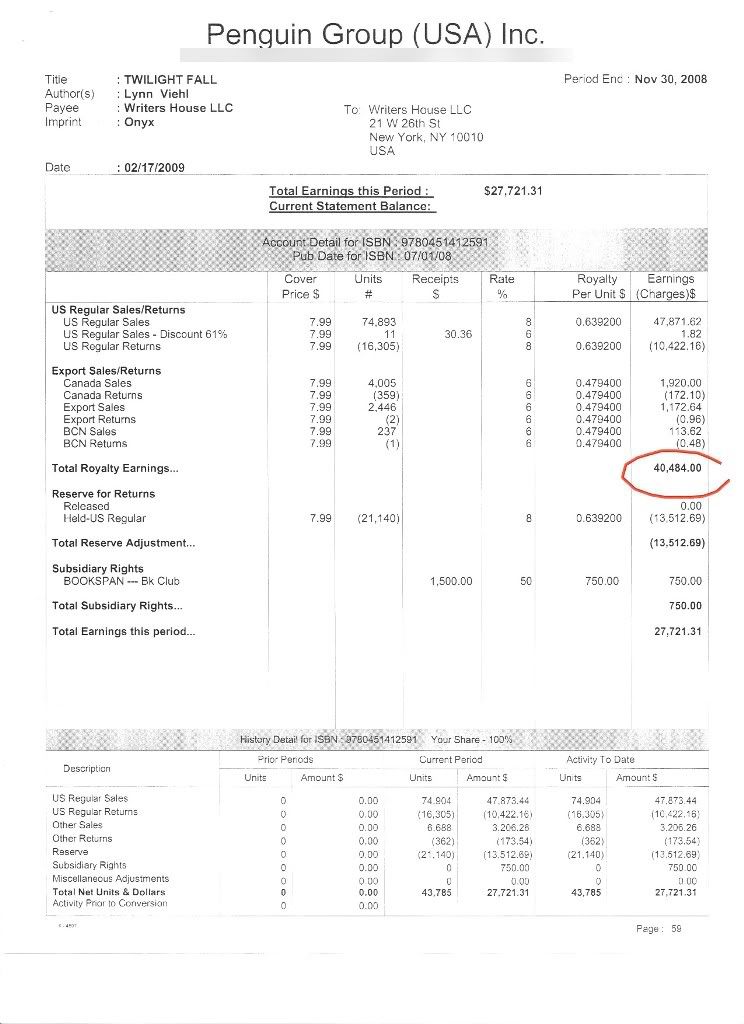
Basically, when a distributor or bookstore orders books, they may not sell all of the books they have ordered. Those books are then shipped back to the publisher. These are known as returns. For each book returned, the publisher loses money.

But it doesn't stop there. The publisher may have already been paid for the books that were returned, and they may have already paid the author royalties based on those purchases (or credited their account). When there are returns, they are debited from any future royalties that may be credited to that author's book. So, not only do returns cost the publisher money, but ultimately they cost the author, too. That is why it is imperative that both the publisher and the author do what they can to minimize returns. More often than not, when an author doesn't receive a royalty check for the quarter, it's not because their book hasn't sold. It's because they had returns. Returns are a black hole in which an author's royalties, and a publisher's profits, disappear.

New York Times bestselling author Lynn Viehl shared one of her royalty statements online to illustrate this point. You'll notice that her returns total more than $13,000 for this particular quarter. Her net earnings for the quarter were $0.

Returns will never be completely eliminated. No title sells out of every single copy ever printed. A return rate of 30 percent is considered "normal" in the publishing industry, but again, these returns cost you, the author, your hard-earned money. Publishers try to minimize these returns by not overstocking the distributor and by printing books in manageable print runs. Many publishers are switching to a "just in time" supply method of printing books as they need them to meet demand.

What can authors do to minimize returns and the damage they do to their royalty statements? Here are a few suggestions:

1. Do consignment events. Rather than do all of your book signing events at stores which order from the distributor, do a consignment event, where you provide the books that are being sold. You'll likely earn a higher profit margin, and the unsold books will go home with you, instead of back to a distributor.

2. Encourage the bookstore to order reasonable quantities. I have had authors get angry with a bookstore manager (and me) because the store only ordered a dozen books for their book signing event. They think the store should order at least 100 copies. The reality is the average bookstore signing sells about six copies. Guess what happens to the other 94 copies? That's right, they are returns, and another drain on your royalty statement.

3. Aim to sell out the store's stock at your events. Selling 6 copies at a book signing event might be a great boost to an author's self-esteem, but if the store ordered 30 copies the author actually lost money on the event. Try to find out how many books the store is ordering prior to the event, and then do your best to sell every copy they have ordered. If the store has ordered 30 copies, invite more than 30 people to your event. If the store sells out, that's fine. They can either place an order for the book through the store, or the store may invite you back for another event.

4. Target venues other than bookstores for signings and sales. A lot of these will either carry the books on consignment, or allow you to do a consignment event. Again, this will help you avoid returns.

5. Sell books on a non-returnable basis. Sometimes authors will hook up with a company or a church or some other organization and sell books to them in bulk. The company purchasing the books will typically get a larger discount, but in return they are purchasing them on a non-returnable basis, which means that sale won't come back to haunt you in the form of returns.

Book marketer Brian Jud once said "Bookstores don't sell books, they display them." That is true to certain extent. Nobody at the bookstore is actively pushing books on their customers. Customers browse and if they are interested in a title they may buy it. Or not. It is up to the publisher and the author to create the awareness and the demand to make the book-buying public familiar with a title. It is up to the author, not the store, to get people through the door for book signing events and to move books at those events.

Do your best to avoid returns, and that will be reflected on your royalty statement.
Share:

Tuesday, April 27, 2010

Guest Post: Thoughts from a Television Producer


Today's guest post comes from one of my co-workers, Amanda Soderberg, who is another great marketing representative at Tate Publishing. She also writes her own blog, Back on the Wagon. She's spot-on with this one. I also recommend checking out my previous post on working with the media. - Terry


Recently, one of our authors contacted a Christian show producer about featuring his devotional on their nationally syndicated show. If I were to tell you the show, 99.9% of you all would know what is is.

Even though we advised a different approach (and offered to facilitate that approach), he was determined to land an interview on the show purely about his devotional.

Here's the blunt response from the producer. I've taken out the incriminating details to protect privacy:

From Producer to Author

Thanks for your response. But we will not booking you for a live interview to discuss your devotional on our show. Our producers want a guest to share his or her personal story of a life transformed by Jesus.
With the TV remote, we have 5 seconds at most as folks click thru the hundreds of channels they can watch, to grab someone’s attention and keep them tuned to our show.

Our producers’ research shows that we build and keep our audience when the audience can relate to a personal story that shows how Jesus changed a life/solved a problem, etc. Talking about your devotional will not accomplish this.


My Thoughts

While this was from a producer of a Christian show, the principle is the same. The way people become guests on tv shows is not because of the product they are marketing, but rather because of something personal that will resonate with the shows' target audiences--something that will catch their attention and sustain it. The product marketing is an addition to the true reason the show producers want you on the show.


Question: Name five things that catch your attention when you are flipping through channels. What platform are they (movies, talk shows, reality shows, commercial, public service message, etc.)? What about you, your life, or your experiences can you relate to those snippets that caught your attention?
Share:

Saturday, April 3, 2010

Guest Post - Your Author Photo: How to Project the Right Image


Some authors write for personal fulfillment or to share with friends and family, but if you want to make money from your book you need to treat it like a business. That means (among other things) that you need to project a professional image.

Your author photo is part of your image and brand. A fuzzy shot of you cropped out of a group photo, with someone's arm draped over your shoulder, just isn't the right image if you want people to take you seriously as a professional author.

An author photo doesn't necessarily have to be shot by a professional photographer in a studio. In fact, some studio portraits tend to look overly formal. In deciding on the setting, pose and clothing for your author photo, think about your personality, the type of books you write, and the brand or image that you're trying to project.

If you write gardening books, an outdoor shot with plants in the background is appropriate. If you write about business topics, you might want a studio portrait in business attire. Some authors take a photo in front of a bookshelf or holding their book, while others just use a plain white background. You can get ideas by looking at photos on author websites or on book covers in the bookstore. See what others who write the same type of books you write are doing.
If you hire a photographer, explain that you are using the photos for business and you will need to receive digital files. If you would rather do it yourself, find a good location and ask a friend to shoot photos with a digital camera. Take lots of shots so you can choose the best one. Just make sure the photo is in focus and free of distracting things in the background. Solid colored clothing usually looks best.

You will need several versions of your photo for promotional purposes. For printed materials like book covers, sell sheets, and magazine features, you need a high-resolution image (300dpi). For online use, it's best to use a low-resolution image (usually 72dpi). Low resolution files are much smaller, so they are faster to upload, open faster as pages load, and take up less space on servers. In your online media room, I recommend offering both high-res and low-res versions of your photo and your book cover.

It's a good idea to use the same photo everywhere – people will begin to recognize you. You may need to experiment a bit to get the best version of your photo for use on social networks. For example, on Twitter it's best to upload a square headshot, cropped fairly tightly around your face. On Facebook, you want to upload a photo that's not cropped so tightly. Facebook will display your original photo on your profile, but reduce it to a square thumbnail to display in other places on the site. See this example:


Most computers come with simple photo editing software. To crop a photo in Windows, open your standard author photo with Windows Photo Viewer, then open Microsoft Office Picture Manager, click on Edit Pictures, click on the Crop tool, then drag the black lines inward until you've captured the portion of the photo you want. Try the Auto Correct button to improve the color and lighting. Click on the Compress tool to create a low-resolution file for use online. Be sure to save each version with a new file name.

Some authors use their book cover or logo as their image on social networks, but people are there to network with people, not with a book. I recommend using your author photo most of the time, but you might want to use your book cover on certain occasions, such as during your book launch.

You may want to update your look every couple of years to keep it fresh. I introduced a new photo in January with the redesign of my website, and it took me several hours to change out the photo on every website where I'm listed online! My photographer took several studio poses, but I liked the outdoor shots better because they were less formal and more colorful. I even wore a blue blouse to coordinate with the blue on my website.

Whatever setting or look you choose, just make sure it projects the right image of you as a professional author.

Dana Lynn Smith is a book marketing coach and author of the Savvy Book Marketer Guides. For more tips, follow @BookMarketer on Twitter, visit Dana's blog at www.TheSavvyBookMarketer.com, and get a copy of the Top Book Marketing Tips ebook when you sign up for her free newsletter at www.BookMarketingNewsletter.com.
Share:

Don't miss a post! Subscribe for updates!

Enter your email address:

Delivered by FeedBurner

Web Hosting

Popular Posts

Copyright © Book Marketing for Indie Authors | Powered by Blogger

Design by ThemePacific | Blogger Theme by NewBloggerThemes.com | Distributed By Blogger Templates20